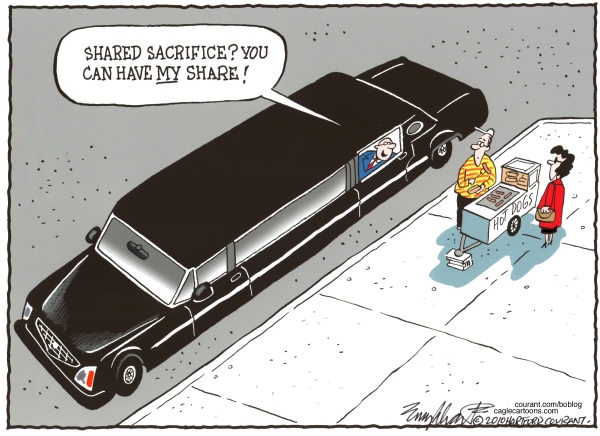
Nicholas Sarkozy came to power five years ago heralded as France's New Man who would yoke France to global capitalism by separating it from its social model. He jogged and he paddled New Hampshire canoes without his shirt. I thought then that it would turn out badly, and it has. The new Socialist president François Hollande faces a mess when he steps out of his democratically little car.
Sarkozy was a classic wedge politician, campaigning against France's supposedly grasping unruly immigrants and its allegedly violent racial minorities in 2007 as he had while minister of the interior under Chirac. Sarkozy brought one of America's most repulsive and ineffective ideas into French politics, which is that solidarity damages the economy and retards society's wealth creators, who should rule by natural right. The practical effects in France have been a minor-key echo of their destructive impact in the U.S.. Sarkozy presided over the piecemeal degradation of two of the cornerstones of
French society, its strict, high-quality public schools and its
affordable, high-quality health care system.
A crucial development in 2011 has been the way the Wall Street has managed to alienate so many of its natural supporters among economists, top economic journalists, and financial professionals.
Lots of mainstream finance commentators finally went ballistic over the state of financial policy. The most interesting group are the professional investors who have turned on their masters. I get to them at the end of the list of dissidents.
The Angry Keynesians. Paul Krugman is Exhibit A, a 1990s liberal free-trader where strong state intervention was the exception more than the rule, but who opposed the Bush tax cuts and for the ten years since has railed tirelessly about every replay of deregulatory trickle-down business-led plutonomics. He summarized the Bush Years as "The Big Zero," denounces "The Austerity Delusion," "The Urge to Purge," "Cockroach Ideas," among many others. The "Economic Bleeding Cure" is a classic of this genre.
Fortunately, physicians no longer believe that bleeding the sick will make them healthy. Unfortunately, many of the makers of economic policy still do. And economic bloodletting isn’t just inflicting vast pain; it’s starting to undermine our long-run growth prospects.
Keynesians care about the development of society, and are confused and enraged by the casual blowing off of these concerns by policymakers in the US and the EU alike. "Well, this is a miserable step in the wrong direction" says Jeffrey Sachs, starting a denunciation of both parties in the US. "From a self-preservation angle, this is lunacy," notes David Dayen.
Nicholas Kristof alienated some Occupier supporters with a somewhat patronizing attempt to suggest demands, but he is also the author of the excellent summation "Our Banana Republic," voicing anger at policy suports for social devolution. But you know these people.
Prophetic Re-regulators. This group consists of high-end experts in technical domains -- mortgage industry regulation, complex credit instruments, international banking relationshiops -- who have become relentless and sometimes furious bloggers. They focus on the non-improvement of the financial system itself -- not so much on its social effects as its continuing rottenness, now propped by massive government subsidies (a 0.16% interbank funds rate for example) and complicity in the perpetuation of the shadow banking system that caused the problem in the first place. You know most of these folks too: the sober Simon Johnson and James Kwak at the Baseline Scenario, Dayen on housing, and Yves Smith at the remarkable Naked Capitalism on housing, banking as a criminal enterprise, and idiotic political dynamics that are forcing a choice between shooting the economy (Republicans) or bleeding it to death (Dems).
Cassandras of Systemic Failure. The lead people here are in Europe, with Martin Wolf at the front of the pack. These are a mixture of journalists and economists who accept the need for "adjustment" of the most crisis-ridden economies -- read drastically lowered living standards for the 99 percent -- but think politicians aren't being smart or independent enough to manage even that. Wolf recently predicted a lost decade unless governments simply cranked up the printing press and created money, denouncing sadism towards populations along the way. He often points out that economic failure was not caused by bad behavior but by not very enlightened market judgements, e.g. public debt burdens that were lower in Ireland and Spain than in France and Germany. This is the Japan Syndrome writ large by pro-capitalists who see that financial corruption and momentum have undermined the systems that made capitalism stable for a while.
Raging Traders.These are working investors, many of whom write blogs to attract customers to their investment business, which often consists of selling their trading advice. Post-facto posts are the sign over the entrance meant to encourage signing up for the live action inside the tent. These people trade every day, feel shafted and betrayed, and are absolutely furious.
Here's the boss of Phil's Stock World on the horn last December talking about Obama's capitulation on the tax cut extensions. Remember, Phil likes numbers.
Good job Congress!
Way to take it from your new Republican Masters! Not since Jack sold his cow for some magic beans has a deal like this been made by our "leadership" where families earning between $35,000 and $64,000 go $7,800 further into debt to get a $613 tax break while families earning between $5M and $10M get $38,590 and families earning $50M to $100M get $380,590 and families (or Corporations, of course) earning $500M to $1Bn get $3,859,000 or about 12,590 times more than the average middle class family but, then again, they deserve it because – they are that much better than you are!
Face it, unless you are in an income category where your tax benefit has 5 digits, you are what George Orwell (who worked in England’s Ministry of Propaganda) called a "Prole." In 1984 the Proles (proletariat) were the vast majority of the populace, the working class of Oceana. Though the proles are the majority, they are unimportant. The Party explicitly teaches that the Proles are "natural inferiors who must be kept in subjection, like animals". As one of the Party Leaders observes: "the relative freedom of working-class people is merely a symptom of the contempt in which they are held". . . .
You’re not going to be any trouble are you? Enjoy your $613, little people. That’s what, about a month’s worth of gasoline and cable TV? Congratulations on your voting acumen – you certainly have gotten the Government that you deserve! . .. .
Congressman Ryan Paul . . . points out: "Whose money is this after all?" It’s not your money that your family is going $7,800 further into debt to protect – it’s THEIR money. THEY earned it and THEY are darned well going to keep it. "Hey," you might say, "I work for THEM – didn’t I make that money and isn’t this OUR country that’s in debt and needs responsible fiscal policy?" Well, that’s just Commie talk and you’d better watch yourself – we’ve already sent your name of to HomeSec so consider yourself on notice…
The Proles in this country are dumb enough but what amazes me is the people who support the tax cuts thinking you are "one of THEM" when "they" look at you the same way you step over a homeless man in the streets. $858Bn is the NATIONAL Debt that we are taking on to fund these cuts. The cuts work out to about 0.75% of your income and your family share of the additional debt burden is $7,800 so, unless you are making AT LEAST $1M PER YEAR as a corporation or individual, this tax cut is a net loss for you. Once you clear that $1M hurdle, it’s all gravy flowing uphill to your plate! Even better if you are a "Corporate Citizen" – you have no real debt obligation to this nation because, like Haliburton and many, many others – you can simply move whenever you want – to avoid taxation AND prosecution!
As Bloomberg proclaims today "It’s a Great Time to Be Rich,"
You can often read this kind fury on Phil's blog. The "Long Con" is a fascinating example for its somewhat Marx-like systematicity. Phil makes his money every day by betting on the blindly destructive greed and cowardice of financial and political leaders, which he describes as such.
The central bankers want us to think their fountains of unlimited imaginary money are our sole hope of escaping yawning pits of economic hell. For these apparatchiks, it's all about hanging on to the levers of power any way they can.
The private bankers claim that if we just turn them loose from the stranglehold of post-crash regulation — and allow them to tangle the world in a impenetrable web of insanely profitable derivatives and bonds again — they will plant our feet firmly on the road to financial nirvana.
To these guys, you and I are just foot soldiers and cannon fodder. Our jobs, homes, wealth, and health? Collateral damage.
Here its class war on Wall Street, not just between Wall Street and Main Street.
My final example is from the Wall Street Examiner, where Lee Adler states, "I Stand with the Protestors." It is a howl of rage that starts like this:
We as a society must stop pretending. Most of us think that we still have money in the bank to protect, so we go along with the game of extend and pretend. For some of us, the game has already ended. The rapacious zero interest rate policy that I call Bernankecide has already robbed millions of savers of their life savings. This is the reality that has yet to hit home for many Americans who are content to wallow in the status quo. Unfortunately, the longer it takes for them to wake up, the worse their, and our, fate will be.
My mother and millions of other senior citizens are among the victims of the game that policy makers and those who empower them are playing. Their life savings are gone because Bernankecide, the financial genocide of the elderly, forced them to spend their principal. Now the government is indirectly confiscating 8% of my income because I must support my mother. That percentage is likely to grow as her health deteriorates.
Millions of other boomers are in the same boat. They are forced to pay this immoral hidden tax because Ben Bernanke decided that the innocent must pay for the sins of the guilty. While Bernanke’s ZIRP goes on allowing the banksters to continue to collect their fat bonuses, it steals the savings of millions of Americans, eliminates their disposable income, and cuts the spending power of millions of others who must now support those rendered destitute. The guilty benefit, and the innocent are punished.
Bernanke knows that, yet he continues to side with the criminal bankers in support of the financial genocide of the super elderly, and their children, the baby boomers who must increasingly support them.
Adler identifies himself in effect as Wall Street's 99 percent - screwed by the investment Bigs and with no end in sight.
In the late 1990s I wrote an article called "Business Civil Wars." It was clearly premature. Occupy Wall Street has brought this last group to the surface, and they are providing endless detail about the contradictory social relations within finance capitalism itself.
Decisions are being made that are wrecking US infrastructure. Expert warnings are everywhere. Decisionmakers remain oblivious. People are drawing the obvious conclusions, and are hearing the voice of doom. Charles Simic starts a recent essay by saying, "I can’t remember when I last heard someone genuinely optimistic about the future of this country."
A large number of financial experts are beside themselves. There's Charles Johnson, former IMF official, professor of finance, co-author of 13 Bankers, in congressional testimony on TARP a couple of weeks ago:
the financial crisis produced a pattern of rapid economic decline and slow employment recovery quite unlike any post-war recession – it looks much more like a mini-depression of the kind the US economy used to experience in the 19th century. In addition, the fiscal costs of the disaster in our banking system so far amount to roughly a 40 percentage point increase in net federal government debt held by the private sector, i.e., roughly a doubling of outstanding debt.
Adjustments to our regulatory framework, including the Dodd-Frank financial reform legislation, have not fixed the core problems that brought us to bring of complete catastrophe in fall 2008. Powerful people at the heart of our financial system still have the incentive and ability to take on large amounts of reckless risk – through borrowing large amounts relative to their equity. When things go well, a few CEOs and a small number of others get huge upside.
A central issue of the current financial period is whether the financial sector will manage to transfer all of its liabilities to the public sector and keep them there. Many people have tied this issue to the Ireland crisis. The Irish public sector is getting slashed not because it ran deficits before the crash, and then saw them become unsustainable, but because the Irish government became the guarantor of 100% of the liabilities of Irish banks. These liabilities far exceeded Irish gross domestic product, and they still do.
The Financial Times ran a good overview on November 17th about the growing isolation of Angela Merkel among European leaders on the debt question. Most commentary presents the German position as hostile austerity: force the Greek public to pay for their debt crimes with austerity and poverty for years to come. There's something to that - much of the German public seems to feel that they sacrificed themselves (with few if any wage increases and service cuts throughout the past ten years) while other countries like Greece did not. But in fact the current German government is also trying to force private investors to share some of the cost. This has been an enormous problem for Western societies, as the financial sector gets governments to pass on the cost of their mistakes to citizens, who pay several times over - actual money and guarantees, zero-cost access to funds for banks that prop restored profits, public service cuts, austerity-induced low growth, and reduced investment in innovation for the future.
As if. You won't want to read the excruciating full-length version of David Schoolboy Brooks complaining about how the pro-stimulus prog economists are wrong even though they are turning out to be right as the recovery dies on the vine. So cut to the commentary and various retorts.
The only interesting thing about this is the development of the term "demand-siders" to describe Krugman, Dean Baker, and other neo-Keynesians who think that people's incomes are an important part of economies and that they should be higher rather than lower. (This is in contrast to the "supply-siders" who came to power with Ronald Reagan, and who used the needs of suppliers, i.e. company owners and investors, as a reason to cut taxes for the high brackets.) It suggests that the Right is no longer able to pretend that the center-left in the US has no coherent economic strategy. This was the core of their "one church" approach to capitalism -they pretended there were no actual arguments against small government, no taxes, no public investment, etc. that needed a fair hearing. They taught a couple of generations of conservatives that all the "liberal" arguments had already been refuted, and they could be safely ignored.
That defense line has crumbled, and the next round of arguments is going to be quite different.
Scarecrow adds fuel to yesterday's post, starting his comment on the G20 by saying, "Unless I misunderstand these stories, it appears the world’s biggest economies just decided, over US objections, to resurrect Herbert Hoover, rebury Keynes and pursue another Great Recession, tanking their economies and putting millions more out of work."
Markets are supposed to create rigor and discipline, to reflect economic reality. In this standard view, the public is seen as self-serving and self-deluded about economic reality. Governments that reflect the wishes of their majorities are almost by definition going to impose inefficient, nostalgic policies suited to a bygone age that discourage their population from adapting to the economic needs of today. Democratic governments are seen as dangerous for the economy. This is why "central bank independence," which is seen as the prerequisite to central bank reliability, means independence from both popular desires and from democratic representatives like the U.S. Congress.
"the markets" can't seem to decide what they want from these governments in order to love them again. Two weeks ago the euro was plummeting because the financial markets wanted more blood: they wanted Greece, Spain, Portugal, and the other currently victimised countries of Europe (Italy and Ireland) to commit to more spending cuts and tax increases. Then they got what they wanted, and within a day or two, the euro started crashing again because "the markets" discovered that these pro-cyclical policies would actually make things worse in the countries that adopted them, and reduce growth in the whole eurozone.
Markets are pushed by investing institutions, which are fairly close to a global monoculture of neoclassical economic orthodoxy. So austerity is always job 1. But orthodoxy recognizes contraction and that austerity policies can make contraction worse. Markets are ruled by an economic orthodoxy that is contradictory and pushes investors in different directions.
Similarly, here's Weisbrot on governments:
Unfortunately the European authorities – especially the European Central Bank – are even worse than the markets. They are less ambivalent and more committed to punishing the weaker economies by having them cut spending even if it causes or deepens recession and mass unemployment (over 20% in Spain). . . .
There is a class dimension to all of this, with the EU authorities and the bankers united in wanting to balance the books on the backs of the workers – and adopt "labour market reforms" that will weaken labour and redistribute income upward for generations to come. The EU authorities and financiers believe that real wages must fall quite sharply in these countries in order to make them internationally competitive – but the protesters are responding with a fiscal version of "No justice, no peace".
In short, "markets" change their minds every few days about the necessary medicine because they really have no idea how to develop economies. Governments are now devoted to de-developing their populations: lower wages is a euphemism for increased poverty.
Economists aren't doing much better, for the most part. Writing in the Financial Times on June 1, the prescient critic of finance Nouriel Roubini contradictorily calls for "radical reform of finance" and for Europe to "deregulate" and "liberalise." And Weisbrot calls for an end to the Euro so that countries like Greece can rebalance by deflating a national currency, rather than calling for EU-based economic re-development.
The only way out is to start by recognizing that markets seek to make money for the people who invest in markets, and do not seek to develop economies. This will help keep governments from catering to them, and impoverishing their populations in the process. It will also relegitimize popular economic demands, which are in fact closer to developmental wisdom than are the self-serving calculations of investors and the central banks who set things up for them.
Democratic theory presumes the long-term wisdom of the deliberative majority. Finance -- via its economic theorists -- has declared itself to be the great exception to democracy, and remains the area in public life where frankly anti-democratic, elitist theory flourishes. It drags public policy in its wake, and in spite of lucid mass hostility to banks, has intimidated and paralyzed the popular reimagination of economics. This has set up a kind of ancien regime within democracy as such. In the arena of financial capitalism, democracy has been effectively canceled.
Either we democratize finance with a basis in a coordinated retheorization of it or Europe and the US will keeping heading straight the poorhouse.
In addition to running good steady commentary on the banking reform legislation (e.g here), Simon Johnson remarks on the Baseline Scenario that "the ideology of unfettered finance is crumbling." Clearly top Obama economics advisor Larry Summers hasn't heard. It's worth watching the clip to see the weird blasé attitude towards "things that happen on Wall Street" - the tone is more important than the words. I'm not feeling the shift yet but he's there and I'm not so here's hoping.
When Obama praises the spirit of piling money higher and deeper as the great Spirit of America, and absolves the bank bonusers of any wrongdoing, he makes no sense ethically or economically - finance and its grotesque incomes is grossly inefficient, really unaffordable in our struggling world. But on the level of simple tactics he makes his alleged crackdown on the banks into a joke. Henceforth all of his stern fingerwaggings will be greeted with a wink and a nod - except in middle America, where the pitchfork crowd signs up for Tea Party populism and waits for the chance to run Obama out of town.
I never thought I'd be seeing him as simply dumb but I am starting to.
The national debt crisis in Greece is an example of a case where a combination of Eurozone rules and financial market pressure will force huge cuts in public spending, damaging both living standards and delaying economic recovery. On Sunday, the New York Timesreported that some of Greece's hidden debt was concealed courtesy of instruments sold to it by Goldman Sachs in 2001. In November 2009, Goldman Sachs tried to do it again. The Financial Times reported today that EU authorities have requested information about the swaps.
Greece's national debt is over 100% of its annual GDP. But this is not so horribly out of line with other countries, as can be seen at left and here.
"High" debt is a matter of interpretation, and 40 years of attacks on the existence of government, the public sector, and public debt as a source of public investments has greatly reduced the markets' tolerance for debt levels that are still well below what seemed normal in times of crisis like World War II. Markets put up with high debt levels during war. If we were serious about, say, decarbonization, we would run 200-300% deficits in gigantic crash programs in solar power, total transportation system reengineering, weatherproofing every building on the planet, you name it, so that there will be great-great grandchilren around to pay the debt we left them.
The interpretation of debt levels as too high is threatening the recovery, since it will force governments to cut spending when they should be increasing it. This is the plan for Greece, the famous land of Generation 800 Euros (youth salaries per month) and meager economic development outside of coastal estates built on land removed from government protection by arson-set forest fires.
Government employment is a pillar of the middle class everywhere in the world. It is also being squeezed everywhere: in Sacramento, California, a moron's consensus reigns on the virtues of cutting state employee salaries 5%. In all countries, public service employment is the crucial gateway to the middle class -- as it was in the United States from the 1940s to the 1960s, for African Americans in particular who faced ongoing discrimination in the private sector. Countries like Argentina that were forced into IMF-style austerity programs that slashed the public sector have one common feature: an incredible shrinking middle class.
Most pundits seem to have learned nothing in all these years. Thomas Friedman recently contrasted two years in the Middle East. 1977 was good -- neoliberal policies implemented in Egypt by Sadat. 1979 was bad -- the Iranian revolution, Whahabi-reaction in Saudi Arabian Islam, etc. But "liberalization" and "modernization" were themselves the source of the radicalization of mass Islam that Friedman deplores. They impoverished the great majority in Egypt, ruined Cairo's public systems for starters (on my recent trip there an archictectural institute informed me that 60% of Cairo's housing is "informal" - built by occupants because the private and public sectors both refuse.)
Krugman points out that the bigger debt problem in the Eurozone is Spain. But for some reason he spends his column attacking the very idea of a single currency in a variable region rather than attacking austerity politics, though he knows in the U.S. case that the focus on debt will kill the recovery.
Since the world needs both recovery and stable currency and debt arrangements across diverse national economies - both of which the financial system has not delivered - Krugman et al. need to figure out how to avoid screwing the populations of countries like Greece. The world has to learn how Greece can have a modern, efficient, green infrastructure with its current economy, and then discover how to provide the same to about 130 other countries that are in even greater need.
If the EU can't fix Greece, it can't fix anything that needs fixing.
One good thing about the 2000s was the expansion of the blogosphere - the quality of available commentary has never been better, and we can access expertise and insight that otherwise would have been limited to a particular college lecture hall or small-circulation speciality magazine. So here's to folks I unambivalently celebrate as creators - Ted Newton and his conceptualization of hypertext, Tim Berners-Lee and the universal resource locator, and the thousands of others who put the Toile together as they say in French.
On the decade itself, Krugman's Zero Decade pretty much sums it up for me so nuff said. Zero economic progress, intellectual suspension between paradigms, no answers to 1990s questions about how to have a productive economy and decent, sustainable life without monopoly rip-offs and exploitation of the global South - actually questions barely asked by the ones in power. The gap between intelligence and leadership seems as large as ever in my lifetime, and I'm old enough to remember Richard Nixon.
On the absence of establishment intelligence in the United States, Jane Hamsher puts it well:
the right, whose numbers are relatively small and whose views are generally far outside of the main stream, has dominated politics for the past 30 years because they made an alliance with the corporations. It’s only natural that Democrats have sought power by replicating that model, even at the price of destroying the illusion that they’re the “party of the people” and fracturing the support that put Obama in office.
The Democrats are trying to secure their political ascendence by tying up the money, no different than Tom DeLay did. But whereas the Democratic Party represented a net to collect and unite those disaffected with the kleptocracy of George Bush, the actions of the Democrats since securing the White House this time around have dimmed the hopes that the Democrats present a real alternative.
The Bush Republicans flogged social issues in order to obviate the need for populist economic measures. They satisfied the base by treating them to a banquet of God, guns and gays while they looted the taxpayer trough. The Democrats, however, are making a sacrifice play on social issues and enabling corporatism by triangulaing against their own base. . . . the White House positioned themselves as “centrist” after the widely popular public option was dispensed with, simply because it was something “liberals” seemed to want too. What they’re forcing, however, is a situation where there is no place for populist liberal discontent to rationally go.
Hamsher ends by seeing a populist alliance opposing "kleptocracy"of the republocrats, but given the 2-party lock this can only be a domestic "war that will last for years."
On the coming War Decade, one need only extrapolate from Glenn Greenwald's piece on the Five Wars and the absence of clear thought about what to do. See also Juan Cole's Top 10 Middle East Crises, which are a fitting epitaph for the decade overall. Obama seems even more manipulable than Bill Clinton by any accusatory nonsense the Right can dream up about his lack of masculine will to kill the terrorists and their infinite threat. I'm also old enough to remember the Cold War, when the hysteria could at least base itself in a opposition to a real superpower, the Soviet Union, and its utterly unconquerable unappeasable ally, Red China. Today's global mobilization against a crazy college dropout who lit his pants on fire only to be subdued by his fellow passangers, all of whom landed safely, and this deranged young man's several dozen committed al-Qaeda allies in Yemen, is frankly pathetic. Some sorryass superpower we turned out to be, shouting and ranting and flagellating ourselves in public over a security lapse, and making ourselves feel better with threats of world war.
The worst part is the shock and rage each time that someone obsessed with the US presence in the Muslim world tries to kill some Americans. What exactly do we expect? Either we are trying to rule the Muslim world by supporting dictatorial governments and reactionary monarchies everywhere, deploying dozens of military bases and advising local governments in the arts of political repression, scrambling for resources in competition with Europe and Asia, and backing Israel no matter how much it colonizes and mistreats its neighbors, in which case a portion of the affected populations will naturally try to kill us. Or we will try to get them not to kill us by creating relations of economic equity, sustainable development, and political democracy with real local control (and hence disagreement with U.S. policy and favoring of local rather than U.S. businesss). Can we grow up enough to even see that there is a choice here? Not very soon, since the rage that suppresses thought is in sync with the loss of collective intelligence we suffered during the Cheney Years. Obama doesn't have the chops to escape.
Hopefully, however, we do. Happy New Year no matter what.
Thanks to Juan Cole for writing up the Top-10 "worst things about the wretched period" of the 2000s - for me the Top-10 signs of decline. Yes, it was a truly bad start to the new millennium for which we have many dumbass electorates and self-serving elites to thank. The decades' leaders replaced negotiation with belligerence wherever they found it convenient to them - really, with Iraq, whenever it felt right. The same goes with finance now and the end - Cole's top 1% who reaped 2/3rds of the gains of the 2000s are getting a free pass from the Obama admin to do as they like. The same goes with the environment, where the failure of Copenhagen to produce targets and timetables in an utterly quantified management culture that responds only to these will mean the reinflation of fossil fuel use - oil sands, clean coal, the whole 9 yards.
The decade began the Era of Permanent Discontent. There were mass protests and opposition to policies like the Iraq war that political and business leaders systematically ignored. Individuals like Dick Cheney were more openly contemptuous of public opinion than others, but it's hard to think of a national or state-level leader who has recently opposed his or her small inner circle or the Ring of Lobbyists - on any issue in order to back a majority view.
Continuing the cycle, obvious rejection of popular positions then produce further protests and widening gap between leaders and the vast majority they claim to lead. Polling data picked it up: rulers implemented positions accepted by a minority of the public, and this is happening again with the health care "reform," where a "clear marjority" wants a public option (October 2009, December 2009), and where political leaders don't, and so there won't be one. In Europe they call this "post-democracy." In California, it is called minority rule, and a UC professor George Lakoff has started an initiative to end the Proposition 13-based supermajority rule for budgeting and taxes. This is a great idea. But it needs to confront an electorate that has no experience with or trust in real majority rule.
The twin of permanent discontent is Permanent War. Bush's "war that will go on for years" has become Obama's Afghanistan escalation and similar rhetoric of standing, dispersed dangers to global security. Apparently no American executive can govern without Cold War-style insistence that the country is in grave danger from all over. The benefits to the military and industry are obvious, and so are the benefits to executive authority. Obama's Wars now involve escalating the drone attacks and secret military incursions into Pakistan that echo the Nixon-Kissinger incursions into Laos and Cambodia that hardened and widened the Vietnam war that they too claimed to be winding down. In the context of majority demands for public health care, better infrastructure, cheaper higher education, green technology, more and better jobs, war has an important role to play. The function of war i to make all popular things impossible.
It's worth nothing that finance has come to play a similar spoiling role. Its absorption of somewhere between $17 and 24 trillion has already killed off any new New Deal for the states and their outmoded intrastructures and social systems (the US ranks 12th to 16th in the social distribution of its own core technologies, broadband access). Finance is increasingly acknowledged to invest largely in unproductive assets, so it's not like we need its domination over the economy because they are about to give back to society - give back new industries, high productivity growth, better living for all.
But the financial sector is good for the political executive function. It concentrates wealth and concentrates the power that goes with it. Wall Street's importance magnifies Washington's importance, and the leaders of each get enormous personal benefit from the acute stratification of their sector, where all meaningful decisions are made at the top. The concentration of finance into a few banks that are too big to fail is also good for the military, which operates on the same principle. Having a superconcentrated financial sector run by insiders has long stabilized corrupt, crony-ridden governments in places like South Korea and Japan. It provides the same function in the United States.
The epoch battle now shaping up is between innovation and control. Concentration and hierarchy are good for control and bad for innovation. You can't spread broadband across income groups if you can't distribute and share because your broadband industry is a plutonomy of interlocking monopolists. But most of our innovation industries, starting with IT, have become oligarchies built up around monopoly rents, and the innovation economist David Mowery has pointed out that software developed with market shares of 80 percent at home and 65% abroad (p 14). Innovation depended on acquiring monopoly control in the post-war market environment - and on large amounts of military funding.
Where are the forces of innovation that can do without this kind of control? Mostly lodged in our permanent discontent. My hope - and fear - is that they will remain dormant until they enter into open revolt against the control-focused governance that now pervades every corner of politics and the economy.
In 1009, Egypt's Fatimid caliph al-Hakim leveled Jerusalem's Church of the Holy Sepulchre to the ground. He then "hacked the church's foundations down to bedrock." The church was rebuilt in 1048, but it's initial destruction became the cornerstone of the crusade preaching of the Catholic Church. His successor would rebuild the church ing 1048, but Hakim's rash act stirs demands in Europe for a Christian crusade to recover the Holy Land from the "infidels." In 1096, the First Crusade would leave Europe for the Holy Land with more than 30,000 men, and would crystallize the anti-Islamic hostilities and salvific-warrior mentalities that seek to control our destiny today, a thousand years down the road.
See My Related Blogging at "Remaking the University"
Most of my on-line work is happening here right now, commenting on the travails and possible death-throes of that archetypal fountainhead of the middle classes, the University of California


 Decisions are being made that are wrecking US infrastructure. Expert warnings are everywhere. Decisionmakers remain oblivious. People are drawing the obvious conclusions, and are hearing the voice of doom. Charles Simic starts a recent