Sunday, April 29, 2007

Sunday Sermons on the Decline and Fall

Our familiar Sunday themes:

-Fr. Frank Rich has an even better than usual piece on our Poodle Press in today's New York Times.

-News Flash: private sector failed to Rebuild LA. Sorrowful views 15 years later (1, 2, 3).

-Catch up on Paul Krugman's demonstration that the U.S. income and wealth spreads have returned to the 1920s or the 1890s, depending on your measure. Contrast it with Human Helium Balloon Tom Friedman's happy Einstein parable of salvation through science education. Why does anyone take Friedman's corporate global future seriously when he is in blanket denial of the corporate global present? A central symptom of that present -- the grotesque and bizarre maldistribution of money -- is noted by Krugman: the top 25 hedge-fund managers made $14 billion in 2006, which would have covered the cost of health insurance for the U.S. 8 million children who current lack it. Remember: soaking the rich does work, financially.

-A federal Court of Appeals immunized banks that helped Enron defraud investors by hiding loses and pumping the stock.

-Public investment stops: watch infrastructure fall. Today the LA Times reported that California's genius Governor, Arnold Schwarzenegger, is strangling planning for a bullet train network, which eventually would have brought this huge state with terrible traffic into the second half of the twentieth century. Today, a gasoline truck completely destroyed a connector to the Bay Bridge that links Oakland to San Francisco. Whoops. A few more people will be taking the train.

-News Flash: racism undermines support for public services! Economists have figured out the obvious, but better late than never.

Wednesday, April 25, 2007

Rich Man Middle Man

The dailies are starting to cover the crazy incomes of hedge fund chiefs. Here's a sample from the Los Angeles Times. At the bottom is this list:

1. James Simons, Renaissance Technologies, $1.7 billion

2. Ken Griffin, Citadel Investment, $1.4 billion

3. Edward Lampert, ESL Investments, $1.3 billion

4. George Soros, Soros Fund Management, $950 million

5. Steven Cohen, SAC Capital, $900 million

6. Bruce Kovner, Caxton Associates, $715 million

7. Paul Tudor Jones, Tudor Investment, $690 million

8. Tim Barakett, Atticus Capital, $675 million

9. David Tepper, Appaloosa Management, $670 million

10. Carl Icahn, Icahn Partners, $600 million.

The assets of the rest of us are starting to flounder. Housing sales were down over eight percent last month compared to the month before. This will soon mean the end of the price inflation that owners used to boost their often-stagnant incomes and that kept many renters locked out of the market. It will be interesting if folks finally start to ask why the new wealth isn't shared like the old used to be.

Sunday, April 22, 2007

Afraid for France

Today's first-round presidential elections in France are making me nervous. What if Sarkozy comes out way in front? What if the second-round consists of a choice between Sarkozy the wannabe Thatcherite and le Pen, the National Front right-wing racist? What if French voters turn out to be as dumb as we are?

Some reasons why they might be:

1. Sarkozy is widely portrayed in the press as a New Man, a bold, vigorous, decisive leader able to break France's attachment to its statist past. France could vote in effect to get rid of its best features - great public services like transportation and health care, and make its crappy features, like its university system and its rigid, top-down corporate world, even worse.

2. France's poor, though a much smaller piece of the pie than in the U.S., are often portrayed as violent, illiterate, Islamic fanatics who refuse to assimilate into France. Shades of Thatcher and Reagan, Sarkozy parades his contempt for the "scum" of the projects in place of meaningful accomplishments in reducing crime and increasing school achievement and employment. But these strong-man gestures please a lot of people in all countries.

3. France's business class is as irresponsible as that of the US and the UK, and incessantly demands lower taxes and easier firings rather than solutions to real social problems like racism, unqualified school grads, social polarization, and - the one we never talk about - clueless business elites who really have no idea how to make their companies excel internationally, and so fall back on milking their own public sectors.The slogan should be "Sarko le mediocre." This is a guy who never had a new idea in his life, who plays the race card and the deregulation card like the Anglo-Saxon right began doing thirty years ago. He would be the worst of both worlds, delivering cronyist neoliberalism in economics (France's biggest companies getting more favors, not getting more productive, and doing less and less for the country), and racialized dismantling of society, exploiting France's diminishing confidence in the value of its great public services and residual egalitarianism.

Is France on a death trip of its own?

Sunday symptoms:
  1. our own utterly decadent leaders, anatomized by Fr. Frank
  2. free market health care strikes again in America's death-trip zone, The South
  3. migrate to live under globalization
  4. finally a non-stupid piece on France in the New York Times
  5. American financial culture's made-up rules: are we smart enough to follow the story?
  6. shareholder votes on executive pay? One small step for reform.

Saturday, April 21, 2007

Blingdexes Boom, Unlike You

This is under the heading of "proof of what you already knew." Robert Frank's Wealth Report in Friday's Wall Street Journal cites several indexes of the luxury consumer sector to show that indexes that track high-end goods have gone up much faster during the Bush years than those that track consumption for the rest of us. Frank writes, "Most of the luxury index have posted an average increase of at least 13% between 2001 and 2006. The Dow Jones Industrial Average, by comparison, has increased an average of 4.7% annually during the same period." And of course GDP has increased less than that. In addition, "same-store sales for upscale stores like Saks and Barneys are increasing at more than twice the rate of the overall retail sector, analysts say."

Another example: Merrill Lynch's new MI LIfeStyle Index (which includes BMW, Porsche, Bulgari, Coach, Burberry, Tiffany, Sotheby's, etc.) "increased 23% in 2005 and 12.5% in 2006 - above the 14% and 7% posted for the Morgan Stanley's MSCI World Consumer Discretionary Index" which tracks global consumer stocks.

And of course the inevitable stats behind this are not long in coming: "The number of millionaire households in the U.S. has more than doubled since 1995," and "the total wealth held by the nation's richest 1% has increased more than 50% since 1998, to $16.7 trillion in 2004."

No wonder we had to cut national higher education funding by over 15% in real dollars in the 2000s, and had to privatize the formerly federal student loan agency Sallie Mae, whose CEO after 1997, Albert L. Lord, made $235 million between 1999 and 2004, and stands to make another $135 on this new deal. (See a good piece by Joseph Nocera, and and another by Julie Bosman on loan companies phony but mandatory "counselling" to students on campus.) Why send two kids to Harvard, or fifteen to Cal State Channel Islands, when you can buy a Bugati instead, make the kids take on debt, and then pay off your Bugati with the interest you make from their securitized debt? This is what makes this the greatest country in the world!

Sunday, April 15, 2007

Goodbye Means Hello

I haven't read Vonnegut in years but I will miss him anyway. I'll miss what he represented - originality and stylistic loopiness that opened up new windows into how people think and feel. I loved how he believed that we could imagine other worlds, and then went ahead and imagined them.

There's some good quotations in this clip from David L. Ulin's obit in the Los Angeles Times of April 13th. But there's also a tendency to cut Vonnegut down to size.

Here's Ulin:
"Slaughterhouse-Five," Vonnegut's masterpiece, is the story of a World War II veteran named Billy Pilgrim who comes unstuck in time. The book is centered around the firebombing of Dresden, Germany, by Allied forces near the end of World War II, which Vonnegut survived as a prisoner of war. It's no understatement to suggest that this was the defining experience of the author's life, not because it made him bitter but because it opened up his point of view.

Close to 100,000 people died in Dresden, almost all of them civilians: shopkeepers, nursemaids, teachers, children. It was a horror so incomprehensible that the only reasonable response was to see it as absurd. For Vonnegut, this was the linchpin in what became a humanistic outlook on the world. It allowed him, in some fundamental way, to develop his own odd bittersweet sense of humor, since he had witnessed such indiscriminate devastation and despair.

What set Vonnegut apart is that, even as he commented on this, he understood there was nothing to be done about it; when he acknowledged, in response to a question from an acquaintance, that he was writing an antiwar book, he was asked why he wasn't writing an anti-glacier book instead. "What he meant, of course," Vonnegut wrote, "was that there would always be wars, that they were as easy to stop as glaciers. I believe that, too."

He was also smart enough to recognize his complicity, the idea that as a writer or observer, he was not above the fray. "One way or another," Vonnegut acknowledged ruefully in 1976, "I got two or three dollars for every person killed [in Dresden]. Some business I'm in."

This willingness to tell the truth would sometimes blur, as Vonnegut grew older, into cynicism. He could be a misanthrope; in his 1991 essay collection "Fates Worse Than Death," he described humanity as "an unstoppable glacier made of hot meat, which ate up everything in sight and then made love, and then doubled in size again," and later he would go so far as to say that we, as a species, had been a mistake.

Indeed, much of his later work was marked by a pessimism about the fate of the world and, indeed, the human race. "The good Earth — we could have saved it, but we were too damn cheap and lazy," he wrote in his last book, "A Man Without a Country," published in 2005.

Still, even the existence of that final effort spoke to an opposing, and more optimistic, point of view.
Actually, no. Vonnegut never thought there was nothing to be done about things like war. He was depressed and "pessimistic" because there were lots of things to do to stop war, global warming, etc. - we just weren't doing them. That's depressing.

He's gone and not suffering anymore. And he's not pessimistic anymore. And not gone - there are those amazing books. RIP Kurt. We will keep working on your other worlds.

Sunday, April 08, 2007

Executive Pay Frenzy at the New York Times

As readers here know, Sunday in America is Class Anxiety Day. The New York Times prepared a special Easter Class Anxiety edition with excellent graphics available on line for a week or so. The anxiety almost spills over into anger and even a little whiff of class war. It is pretty outrageous, what you can do by studying 200 "large public companies" and the pay of the top three folks. Look at the graph to the left. I don't think I have the heart to write about this long enough to get to the bottom of this insane, stratospheric spike they've given themselves - oops, I made it. The big spike is actually the top 10% of executives, showing the nutty spikes within spikes of the inequality that has become our defining national feature. My gut reaction is that these guys at the top don't care about anything - the country, the economy, the people, the environment, nothing outside of crushing everybody else in whatever game they think they're playing. Maybe they'd pay attention if somebody tried to raise the 15% capital gains tax rate back to the 38% or whatever the hell the top bracket is in this country of clueless leaders. But global warming, civil wars, blown up in the market, starvation and drinking water for a billion people that makes you crap your guts out: these guys can't do a goddam thing except make it worse, so you wonder why we're paying them anything. It almost makes you wish the Second Coming would come right now. Happy Easter everyone. I need another chocolate bunny.

Thursday, April 05, 2007

Restless Scarf Day

Today I had lunch with my brother upstairs in a good hole-in-the wall mom-n-pop restaurant in the Galerie Vero Dodat, just off the Palais Royal which was looking mighty good in early spring as we walked through. We talked about about all sorts of things, particularly the upcoming presidential elections here in France, which as Americans we feels we've already lived through. Sarkozy the candidate of security, patriotism, immigration controls, and the deregulation of business; Royale, getting called inexperienced and indecisive and going down in the poles. Sarko is the culture of force brought to France, and of cronyism already here, and of Blairite privatization which means giving businesses slices of government activity thus driving up costs, allowing business to declare government inefficient and taking even more of the action. Maybe Sarkozy can bring HMOs to French healthcare so the French can pay three times what they do now, making them "efficient" like us. Naturally, Brad says, much of the middle class supports Sarkozy.

But what the hell. Things feel less urgent in Paris, which has survived centuries of lying and stealing leaders. The Palais Royal was the original fusion of government and retail, built for Richlieu in the 1630s and combining over time royal apartments and every variety of snobbery and trade. After lunch we walked down rue de Rivoli, the heart of middle-brow commerce, and then I continued on across the amazing Seine on an early spring day that combined an unsteady, chilly north wind with lots of unbroken sun. I passed la Conciergerie with its famous round towers, the heart of the old monarchy and of royal imprisonment and then past le palais de justice, the heart of the law, and on to Notre Dame de Paris. As ye olde Catholic atheist, I visit cathedrals every chance I get, including ones I've visited dozens of times before, like this one, a destination of one of my traditional Paris walks. If you asked me "what is European civilization's single greatest achievement," I would immediately reply, "Notre Dame."

I looked at it today and thought of what Avery says about the ruins at Jumieges. It used to be powerful and evil. Now its power is gone, and it is peaceful. And beautiful, beautiful, beautiful The beauty does mean something. It always gives me hope. The structure, the ornament, the entire world of humanity represented in the figures - all speak of the authority of god, which leads to fixed, rigid, absolute hierarchies on the facade. I like watching the unstoppable mobs of tourists in the parvis in front. They are amazed by it, and excited, at least temporarily harmless and at peace themselves, taking pictures and pointing and deciphering and perhaps they wonder what I always wonder - how did those European barbarians, those superstitious fanatics, those ignorant pretechnological killers, make something as beautiful, as overwhelming as this? How did they do something this right?

They knew many things that we have forgotten. They had labor and craft, and art was central to the ways they honored the universe. They were doing much better at that than we are.

I stared at the central portal as I always do. There are the saints standing on the backs of the servants who twist their necks to look up at them. There are the rows of heads ascending and descending. There are the fake kings looking down, the substitute statues after their forebears were pulled to the ground during the revolution. The destruction of the kings was the beginning of the ruin, and the romanticism, and Hugo's novel that brought people back to the building to look up at it. The end of the kings was the start of the peace.

The revolution left the central portal intact. There is Christ on his throne. Below him an angel conducts the weighing of souls. The saved are directed to heaven. The damned are directed below.

The saved and the damned - this dichotomy is the central mistake of Christianity. This is not Jesus, the great anti-imperial thinker of community-based higher things. This is Christ, whose status as himself divine supposedly ratified church power and what better way to show his power than by damning souls to hell? Really, what worse way? The reflex of damnation - it's nearly been the end of us all.

After weighing the weighing of souls yet again, I walked around to the back, past the pink and the green flowering trees, and the smiling grandfathers having their picture taken, and the boys happily strangling each other on the pavilion. From the heart of the church I walked to the Jardin des Plantes, the heart of old French science, fully repaired, spreading out flat and wide and endlessly in the distance, with the Galerie de zoologie majestic and undisturbable in the distance, wide and high and forming its own horizon. Manet-like tableau sur l'herbe occurred at regular intervals - a teenage girl helping an 8-year-old with her homework under the pink petals, a 4 year old girl in a red coat amiably kicking her way across the crushed granite earth, clumps of shouting schoolkids, businessmen blinking in the sun as they talked on the their phones. I went out the front and walked by the great Mosque, the old heart of Islamic France. I couldn't go home without stopping in at the 5 a Sec on Saint Marcel to see if my regular laundress was there, and thankfully she was. Something else to look forward to.

My scarf took off in the wind about 50 times during the walk. Happy to come back, but equally happy to go.

Wednesday, April 04, 2007

Robbing Thy Pension

Today's New York Times has a good investigate article about budgetary deception and the siphoning of the teacher's pension fund in the state of New Jersey. "I'm from Jersey" jokes aside, New Jersey is a wealthy state, in per capita income not far behind Connecticut and Massachusetts, ahead of New York, and way ahead of California. So it's particularly ominous that the state has been robbing its teachers to pay its contractors, or its pension consultants at JP Morgan - or somebody, who really knows. This is not a conspiracy against middle-class social services - it's just part of the overall disdain and carelessness regarding public sector resources that create a phony sense of their inefficiency and, more literally, gradually destroy their solvency so after lots of sighing, lamentation, and handwringing our "responsible" public officials - usually Democrats - can clean up the mess by cutting payouts, taking new employees out of the pension altogether, and increasing everyone's insecurity. Actually this downsizing of public pensions and benefits is the specific goal of business roundtable-like organizations like the Rich Citizens Public Budget Complaint Committee, known more formally as the CBC, which constantly argues that public employees don't deserve good pensions because their wages aren't as grossly substandard as they used to be. Well too bad, it's your fault for choosing public service when you could have been an IP lawyer . . .

Saturday, March 17, 2007

Middle Classes of the World, Unite!

It would be nice to see the middle classes in the US protest when they get screwed. The war in Iraq has as of this minute cost about $410 billion. See the counter at the National Priorities Project, which points out that this amount is the equivalent of almost 20 million scholarships to college for four years. The human but also the social and monetary waste is literally crazy. Happy Fourth Anniversary of the start of the Iraq invasion. This is the war that no level of protest OR of human rights violations, mayhem, or strategic failure has affected. How do we make it stop?

Those middle-class protesters in the picture are lawyers and their supporters in Pakistan. The shot was taken March 14th, when lawyers took to the street to protest after Pakistan's president, Gen. Pervez Musharraf, fired his chief justice. Salman Masood reported to the New York Times that "Hundreds of lawyers gathered outside the Supreme Court to give Chief Justice Chaudhry a hero’s welcome. Wearing black arm and head bands, lawyers and activists chanted slogans — 'Go, Musharraf, go!' and 'A regime of bullet and baton will not do' — in the face of a heavy contingent of police officers. The Chief Justice had been suspended on the basis of secret charges.

The suspended Chief Justice, Iftikhar Mohammad Chaudhry, had clashed with Musharraf in the past, particularly on the issue of "forced disappearances," unlawful detentions of people by the government's security forces. Chaudhry was liked to have presided over a challenge to the legality of Musharraf's occupation of the presidency. More recently, Masood writes, "Chief Justice Chaudhry had considerably embarrassed the government by overturning the much-publicized privatization of a steel mill, which tainted Prime Minister Shaukat Aziz for approving the underpriced sale of a major national asset."

Governmental lawlessness, the routine disappearing of dissidents, crony-driven privatization, the crushing of an independent judiciary - they all violate the basic tenets of the "open society" that capitalist markets are supposed to guarantee. Elites who want capitalism should help their restive middle-classes to defeat this kind of tyranny. If they don't, middle-class movements will more widely equate capitalism with tyranny, just as many of their working-class predecessors did.

Thursday, March 15, 2007

Smarter Than Their Parents

The LA Times has a story covering the UC Regents meeting yesterday, where they voted 13-6 for a 7% increase in undergraduate fees next year, raising the average annual tuition for a UC undergrad to about $7350. The frame successfully created by the Office of the President (UCOP) was that it would be worse for you if you lived in Texas or Virigina, where fees are higher, so look on the bright side. This doesn't change the fact that the state is steadily replacing public with private funding, and that the university's social and personal impacts will change as a result. We'll talk a little about this in lecture today.

Another ominous note is that the Regents approved a proposal led by the law schools at Berkeley and UCLA to remove the cap on tuition increases there, meaning that they will soon rise from their current level of around $25k to $35k or more. The damage to public-interest law is obvious, since now even graduates of public universities can't afford to take the five-figure jobs that those non-profit entities can afford to pay.

The damage to the concept of public higher education is subtler but just as deep: as students and parents pay more for eduation out of their own pockets, they are naturally less interested in paying more for education in taxes. A few of the protesting students mentioned that the "high-tuition, high-financial aid" model wasn't working for them, but most people haven't figured out that only public funding can support higher ed that combines high-qualty with high-volume. That includes the middle-class folks who in many cases are middle-class only because they took a few steps up the social ladder because of very cheap but very good college instruction. To repeat a lecture question: will the California middle-classes give away the conditions of their own existence?

Sunday, February 25, 2007

Republican Columnist Sees A Lot of Pissed-Off Indians in His Future

Ben Stein watched TV in a hotel, fell asleep, and dreamt class war. Well almost. This is America, the classless society. But the New York Times's Ben Stein got upset nonetheless.

I recognize the experience: he doesn't watch much TV (at the moment I'm restricted to DVDs of last season's Battleship Galactica), he gets his news from places like the Wall Street Journal and the New York Times, and then he's by himself in a Houston hotel and clicks on the TV:
I watched a show called “The Big Idea With Donny Deutsch.” It was about lavish parties. Now, you remember how we were having those tax cuts for the very rich so they could invest more and make America grow? Remember that?

Well, surprise! Some of that money is going to lavish Sweet 16 parties and $10 million bat mitzvahs, with Tom Petty and Kenny G and private jets flying the guests around. Five-hundred-thousand-dollar parties in New York and Malibu are no longer at all unusual. Even million-dollar parties for the rich are not out of the ordinary, according to the party planners on the show.

I started to feel hysterical. Is this what America is all about? We’re in a war and we cut taxes to stimulate the economy — and it probably did — and we are having million-dollar parties at home while our soldiers are paid starvation wages to offer up their lives in Iraq? We’re in a war and the government cannot afford to pay for adequate training for our soldiers, but the society at home is routinely having million-dollar weddings and bar mitzvahs?

Can anyone say “The Decline and Fall of the Roman Empire”?

We are creating a debt that is about $3 trillion greater than it was when Bill Clinton left office, and one sequel is $10 million birthday parties? Is this what supply-side is all about? To obligate future generations so our generation can have $10 million parties for teenagers?
Yes it is, Ben, what's the matter with you! Our children will be much much richer than we are so who cares? In America, freedom means freedom to spend your money any way you want. So if you spend on a party in one day what it would take ten people making the average American wage of $1 million per year a whole year to earn, so be it. After all, the same free market that creates $10 million kid parties has brought the average annual wage in America to $1 million. So if ten people work a total of 3000 days for a one-day party, what's the problem?

Think of the alternative, like the socialist economies of Western Europe. If America had public services that burdened business - universal health care, good social security, subsidized mass transit, high-quality yet low cost universities, whatever - we would have a median wage somewhere in the socialist neighborhood of, say, $44,300 a year. That would mean, rounding off, that the same $10 million kid party would take 200 people working for one year to pay the catering and decorating and private jet bill, or one person working 200 years. This would violate the American spirit of fair play. Luckily, American wealth-creation has put $10 million parties within reach of the average worker, and the home equity in our $18 million average houses is more than enough to borrow against.

Just think how upset Stein would be if he woke up in Paris!

Sunday, February 18, 2007

A Dishonorable Schoolboy

I start most Sunday mornings by reading a Sunday sermon, usually Frank Rich’s New York Times column on the Bush Administration and its sins. Father Frank’s sermons resemble one another, which makes them very reassuring. The Bush people did last week more or less what they did the week before, which gives the world a certain horrible orderliness.

Father Frank was stressing the tangled web of alliances wrought by American stupidity, and my eyes wandered into the next column where everything is always perfectly simple - the column written by David “Schoolboy” Brooks. Schoolboy was expounding on some half-learned lessons from evolutionary biology (actually he’s doing evolutionary psychology, but whatever): the “content of our genes” make us do bad things, this has always been true, it will always be true. Hence the Schoolboy title, “Human Nature Redux,” and the capitalized clichés from Steven Pinker and Thomas Sowell (lumped together with Adam Smith and Edmund Burke), half-baked together in a Schoolboy Pie.

I was reading along waiting for the pie’s razorblade to appear, but where was it. “Today, there really is no antinomian counterculture - even the artists and rock stars are bourgeois strivers. Today, communes and utopian schemes are out of favor.” What the hell is he going on about, I asked myself. I always approach Schoolboy knowing that he is actually the most ambitious of NYT columnists, since he does The Culture and is always saying We Moderns or We Americans or We Humans are Really Conservative. In other words, Conservatism has nothing to do with Bush, Rove, Iraq, or shortsighted, obnoxious, selfish financial elites. These for Schoolboy, never forgetting his intro philosophy class at the University of Chicago, are fallen faded images of Platonic Conservatism, which is infinitely great, and universally True.

Back to that paragraph about Today: “People are mostly skeptical of social engineering efforts and jaundiced about revolutionaries who promise to herald a new dawn.” Hmm, I think, Schoolboy has written that exact sentence in about 150 columns already. But then the razor-blade appears: “Iraq has revealed what human being do without a strong order-imposing state.” Ah ha! Schoolboy Sez: I didn’t chop down the cherry tree, an Iraqi did!

Of course the Iraqi debacle is the Right’s solo show, much more so than was Vietnam, and they have lied big time to make it happen. Now they are doing the most desperate, high-intensity, bullet-sweating blame-shifting in recent history. It wasn’t our clinically delusional stupidity and wholly wrong philosophy of life. It was the Iraqi People. Since Schoolboy is the Right’s pop philosopher, he deepens the stakes: It’s the weak, lazy, quarrelsome, violent Iraqi people, as tied to unpoliced human nature itself. The Schoolboy’s Solution is more force from above, not less. And since the Iraqis are living in a Hobbesian state of nature, that means more American force.

Calling Brooks “Schoolboy” makes him far more innocent than he actually is. He’s a product of the Right’s think tank networks, which produce knowledge that justifies preconceived conclusions: funders endow these think tanks knowing that all research will confirm conservative doctrine, or at most update it. It’s this same process of fixing the facts around the policy that delivered Iraq on a silver platter. Schoolboy has been operating like this since he graduated from college. So today he writes a column that is a justification for the failure in Iraq, but makes it sound like a scholarly mediation on human nature.

Why does this crap work as well as it does? Well as my friend Andi says, “People Is Dumb.” I would add that Americans is dumb about social causality. Schoolboy can be a great cultural philosopher because thirty years of Schoolboy-type pseudo-scholarship has cut our cultural IQ in half. He’s so much more pleasantly brainless than Father Frank.

Fr. Frank has a causality tale to tell, but first you have to read 14 paragraphs of fairly intense prose. Here’s the good father main point: “What makes [Mr. Bush’s] spin brazen even by his standards is that Iran is in fact steadily extending its influence in Iraq - thanks to its alliance with the very Iraqi politicians that Mr. Bush himself has endorsed.” What! That’s quite a neck-snapping Space Mountain hairpin turn, Fr. Frank! Fr. F. spends the next paragraphs explaining himself by discussing the only slightly hidden anti-U.S. political ties of Bush pal Abdul Aziz al-Hakim, Iraqi president Nuri al-Malaki, and the former US-installed Iraqi prime minister Ibrahim al-Jafaari. Are we actually Schoolboy dumb enough to be unable to take this in? Delivering us therefore to “Iraqi Redux,” aka war with Iran?

My Sunday thanks is as follows; thank you, Fr. Frank, for trying to save us from being Schoolboy dumb.

PS. For another exercise in Recovered Causality, see today’s Louis Uchitelle’s NYT Week in Review piece, “Nafta Should Have Stopped Illegal Immigration, Right?” Turns out that free market economics didn’t revive the Mexican economy but hurt it. Turns out that the free market didn’t reduce illegal immigration to the U.S. but increased it. Woah, Fr. Louis, too fast, you’re hurt my neck!

Sunday, February 04, 2007

Losing Our Way

Last weekend I was in Durham, NC and this weekend in Nashville Tennessee. Both times I’ve gone to these heartlands for the universities - to give a lecture in a conference at Duke and to see friends that teach at Vanderbilt while Avery speaks at a conference. Things in America don’t look any more normal from here.

My pal Jan opened the Duke conference by saying that the American university has lost its way. True, and the same could be said of the country as a whole. But it could also of my friends as a group. They are some of the best educated and most brilliant people around, and yet its hard not to feel like they’re going through the motions. They have all this knowledge but what is it for? They know these things but what good does it do? They say all these things but who is listening to them?

All around us people who know nothing have tremendous effects, supporting leaders who as my Republican dad pointed out in 2003 “kill people for no reason.” Now every week the dying gets worse in Iraq, in Gaza, in other places we meddle and lend our support. And at home we are pretty sure there is nothing we can do.

My Nashville hotel window faces south. It snowed last night but that has melted away. In every direction I see cranes and half- buildings. They will join the hodge-podge of old brick buildings - 3 and 4 stories mostly - and new condo and office stuff whose color you can’t remember five seconds after you stop looking. Buildings are scattered here and there, and there’s a church’s gothic tower, and the white dome of a quad building on Vanderbilt’s campus. But the idea of coordinating anything wouldn’t arise - it would take concentration, it would take planning, it would take thinking.

A few people are still doing that. They are mostly inside corporations. My friend Dana’s husband Tom tells me as we drive towards downtown that they are going to build a new tower that’s just eight stories shorter than the Sears Tower in Chicago, making it the second tallest building in the U.S. Well why not add 9 stories and go for number 1, I laugh? The buildings they have now are what, 35 stories at most? That’s going to look pretty desperate. We pooled all our money and built the second tallest building in America, where it stands out like the Washington Monument in a lagoon.

We drive by an abandoned 1 story brick strip that could offer street life and shops - the kind of things Americans fly 8000 miles to Paris to get. It could even be connected to another block just like it, and to a couple of others, and with 5 blocks of shops pretty soon you’d have a town. They have some stuff like that down by the river, 2 or 3 blocks of restaurants and bars. Nobody will pay to paint the little buildings, but they’ll build a tower 5 times taller than anything else now in town. We walk across a bridge by the Country Music Hall of Fame. It crosses the Cumberland river, and there’s the new stadium for the Tennessee Titans. Tom tells me it’s built on 10 Indian burial mounds. They saved two in the foreground. I take a picture. Then I take a picture of them, with the Nashville skyline behind, minus its Sears Tower to come.

I liked the Country Music Hall of Fame OK, but it needed a lot more about the culture and the business the music came from. There was a lady in there who opened all the doors on the gold and platinum album displays to hear the song inside, and she tapped her feet and said some of the words to every one. She was the only one of us that wasn’t kind of wandering aimlessly. Where have we come from? What have we done?

Personally, I don’t know what this country’s trying to do other than make money, enormous money, money that buys the immunity of a private island. One half of our elites go around destroying stuff . The other goes around making more money than any group in the history of the world. People who are trying to do something other besides making money seem as lost as the country’s foreign policy. We don’t think anyone’s waiting to hear from us. We go about our business, and work at staying happy.

Sunday, January 21, 2007

Today's Sunday Dumbness: Star Economics

This is 50 million dollar man David Beckham - 50 million a year that is, "earning" his money by risking brain damage every day. He just signed with the L.A. Galaxy in a deal that should allow him to earn that amount each year for many years, in what is the galaxy's most pathetic soccer league. Though his best years as a player are behind him, his best years as an L.A. star are not. This is apparently why his personal salary, as Daniel Altman points out in today's New York Times business section, is as big as the payroll for the rest of the league.

We are now regularly confronted with individuals whose salaries higher than that of entire towns. Quite often our response is to fall on our knees and worship them, and then give them everything they want. This is of course a sign of our advanced mental degeneration, an index of a Rome-like empire on its last legs. Or is it? Luckily the business pages are there to save me from the agrarian populist in me that thinks Beckham is a vampire waiting to find his Buffy. Thank you NYT.

Daniel Altman tells us that there's this thing called "star economics," and it has a theory. The theory
is that an enterprise can’t distinguish itself just by maintaining a high average in the quality of its work force. It has to have a star, a breakaway figure, to attract the attention of customers and to inspire its own employees. Moreover, the received wisdom is that a business can’t do all the things that we now think are so important — “taking it to the next level,” “thinking outside the box” or “beating expectations” — without a star leading the way.

Another way of putting the theory is that people are sheep, including the people that run big businesses like pro sports teams. Or alternately - the agrarian populist in me of course loves the people - that the product is no good on its own, so needs some kind of hypnotic trick. This is of course the core objective of advertising: create a need that doesn't yet exist, or magnify a small need into a big one. So firms that make dubious products will now spend any amount of money making those products look beautiful and good.

The question is where does this money come from? The amounts are incredible - in 2006, the New York Yankees 40-player payroll was almost $195 million, or nearly 4 Beckhams. The sources are complicated, but they boil down to the consumer of the product, including the consumers of the cars and beers that advertise and of the products of the corporations whose luxury boxes and other expenditures supply a growing slice of pro sports teams' revenues. Nobody puts a gun to our heads to force us to buy this stuff.

The problem for me is that it's impossible for anyone to tell how it works by reading articles even in more or less the best newspaper in the country (with undoubtedly the best business section, by far). Here's the kind of crud you have to wade through (Altman again).

The economy certainly seems to be producing more stars. The highest-paid Americans are leaving the rest of the work force further behind almost every year. A combination of factors is behind the trend: the huge opportunities offered by globalization, the sudden popularity of hedge funds, the heady climate of innovation in high technology, the enormous pay packages offered to top executives, and more. The economy creates stars. And the more that employers chase them, the greater their radiance.

Yet one could argue that in corporate America, at least, the heyday of the star system has already passed. Even Jack Welch, the nation’s favorite management guru, now has his critics.
As an explanation, this is dead on arrival. It can't even tell the difference between a cause and an effect. Executive pay is not, for example, an effect of globalization, but an effect of an elite culture whose tiny membership compete to stay ahead of each other. Globalization as we know it, driven by companies seeking the cheapest wages in the world and global reach, is in part the effect of absurd executive salaries. It's more complicated than that, sure, but you'll never figure it out from the newspapers. Stars are produced, globalization and hedge funds appear, engineers bring forth new thoughts at dawn, crows fly east before the gathering storm, blah blah blah, and then "the economy creates stars." Actually, no.

The economy doesn't create stars, people do. In particular, people in power with bad policies. But why go into it: who's paying attention? We live in a culture that is completely intimidated by money and prone to superstition and hero-worship. Does the U.S. really believe in democracy? Can you have democracy in a "star economy"? Can you have self-governance when some people make 1000 times more than the next person?? Jefferson would have thought we are insane.

Let's count the way the French do, in terms of the time it takes for one person to earn as much as the next. If you make, say $50,000 this year, you are above the median income in the United States - middle-class we might say. To earn Beckham's annual $50 million, you would have had to start working one thousand years ago - around, say, 1066, at the Battle of Hastings when the Normans invaded Britain. And that's just one year of Beckham. To earn two years of Beckham, you would need to have started to work when Jesus was born.

Too bad you can't bend it like Beckham.

By the way, the NYT reported a few days earlier that the cost of immunizing all the world's children against measles, whooping cough, tetanus, tuberculosis, polio and diphtheria, is $600 million - or a little more than 10 Beckhams.

Friday, January 19, 2007

The Fed and Your Wallet

This is Ben Bernanke, Chairman of the Federal Reserve bank. He is about to explain to Congress why they have to cut the programs that created and still support the existence of the American middle-class.

Cynics would say that this is the Fed chief's job. He chairs our "independent" central bank, meaning that the bank is not under the direct control of one of the three branches of government, even the one, the legislature, that represents the people. The bank is therefore free to reflect the world view of the people who staff it, known as "bankers" and the economists that are acceptable to them. The Fed chair is also free to testify about this or that danger in a way that sets the economic agenda for politicians and the press - two groups notoriously not independent in their economic thinking. The Fed is free to serve its most immediate and powerful constituency, the financial community.

The photo comes from the New York Times's coverage of Bernanke's Congressional testimony, entitled "Fed Chief Warns that entitlement growth could harm economy." There are two things to say about this.

First, Bernanke makes the mistake most of the press likes to make too. He lumps all entitlements together, so that Social Security is a huge problem along with health benefits. In fact, Social Security is not a problem. As the economist Dean Baker has pointed out weekly during most of the Bush administration, Social Security has no deficit at all, and can pay all scheduled benefits with no change in contributions through at least 2041. Health care costs are, on the other hand, a big problem, running long-term costs around eight times higher than social security. Reigning in health care costs is not a question of reigning in "government spending," but of reigning in the cost of health care. It's a government problem only because the government has to deal with the same thing we all do: American health care costs more than twice as much as the next more expensive system in the world, and delivers about the 30th best care.

Second, why are the programs that benefit the economic majority always the official problem? Why isn't Bernanke upset about corporate tax cuts, profit offshoring, the fact that we are spending $8.4 billion a month making Iraq worse, or the grotestquely inefficient, growing concentration of wealth that does not flow back to cover government costs?

Bernanke made useful if familiar points about sloppy spending and its price - e.g. the national debt will be 100% of GDP by 2030 and interest charges alone will triple to 4.6% of GDP. But until he can take on inefficient wealth as well as necessary health and retirement programs, he should be ignored.

Monday, January 15, 2007

Happy MLK Day

Overall this country still doesn't know how to celebrate Martin Luther King's birthday. Blogging in the New York Times, noted literary critic Stanley Fish decided to reflect on what KANT thought about affirmative action, and the other four-letter name that begins with K didn't get a mention. Seems Kant wouldn't have approved of affirmative action because of its faulty universalism, which Fish doesn't mean as an argument against affirmative action, but he doesn't feel good about it like he used to. Whatever. Pretty much sums up the general mental feebleness on all the social and cultural subjects King felt strongly about, like racial equality. What if we just said racial equality, we're for it. Yes, equality of OUTCOME. If there are gross racial disparities, there is racial discrimination, period. Sigh. I'll guess I'll go stand in line for my school voucher.

Why did I like King so much as a kid, a first-generation white-collar white kid in the western suburbs of L.A.? Well he was against racism, which was great, especially post-Watts 1965 - that was my city too that was going up in smoke, and the city fathers were clueless, the voters kept rejecting a rail system so I was never going to get out of the burbs, and there was a gubunatorial candidate named Reagan who was running for office against the long hair and wild music at UC Berkeley, i.e. the stuff I played every afternoon on my record player that made me feel really alive. The poverty and the racism were obvious, let's do something shall we? There was King, standing up against one catastrophic mistake after another, getting hosed, bit, jailed and insulted, and standing up again. And yet he went to protests in a suit and tie, and talked in church like a preacher and a teacher. He was the only thing I'd ever seen that looked like the kick-ass middle class. Fighting for something - including itself.

The Black civil rights movement was one of the only times in modern American history that a middle-class stuck with the working class. The main time for whites was the 1930s, when most whites knew that being poor didn't make you part of a degenerate underclass. Most of us seem to have forgotten this obvious fact. Black folks still haven't, and they were extremely clear about that during the 1950s and 1960s when King was operating. There were differences in Black ranks, but the poor didn't get pitched over the side by their own people. King's last speech was in Memphis, where he'd come to support a sanitation workers strike.

Racial equality? The economic majority? Sounds better than Kant! Happy Birthday Dr King.

Sunday, January 14, 2007

David Brooks's War on the Middle Class

New York Times columnist David Brooks presents himself as the middle-class's great advocate and friend, which makes his presence in this leading newspaper and on public television all the more insidious. His column today is a good example.

Called "The American Way of Equality," it showcases the Brooks Formula for keeping the middle-class in its mental diapers.
  1. admit income inequality is on the rise. (Brooks resisted this simple fact for years, but better late than never.)
  2. say Americans have always been opposed to inequality.
  3. assert Americans have always been opposed to government remedies to inequality (read "redistribution").
  4. resolve the contradiction between (2) our American opposition to inequality and (3) our opposition to fixing it by defining (2) out of existence. Today's version is this: "When Americans use the word 'equality,' they really mean 'fair opportunity.'"
  5. say America does have fair opportunity.
  6. Conclude that therefore we have no problem of inequality.
Some dismiss Brooks as that perennial seminar student - the eager junior among seniors - who likes the big ideas but never quite gets them right. I don't dismiss him. Brooks is a soft Darwinist and hard antiegalitarian who sees our inequality boom as the natural order, but wants us to feel happy about it.

Brooks gains influence because of his sincere and continuous efforts at consolation. He is the domestic counterpart of Thomas Friedman on the globalization front. The success of both men suggest that their middle- to upper-class readerships do prefer concentrated wealth to social justice, but don't want injustice to be too grim. This mentality has been in unilateral control of U.S. economic policy for three decades.

So it's worth saying what's wrong with Brooks' argument. The single biggest error is the idea that the "activist state" exists only to redistribute income out and down - from the upper to the middle and working classes. In fact, business and political leaders have long used the state to redistribute income upward. This takes the form of massive tax cuts for corporations and the wealthy, steady or increasing tax burdens for the middle, subsidies and other public grants to persuade companies to stay in business, cuts in services on which the middle class depends - health and higher education heading a long list - among many other policies.

The Right's activist state has also created a shift in Brooks' beloved "values," so that layoffs, both blue- and white-collar, are seen as an organic feature of nature's economy, while union organizing is a parasitic blight. (Remember "community -employee ownership" campaigns to buy steel companies that wanted to shut down? You don't, because they quickly disappeared. Organizing to save jobs was too "activist.") For Brooks, only liberals are activist when they write contracts or tax code or legislation. When conservatives do it, to systematically favor the rich, they are merely unshackling the Great Producers to whom we owe all wealth our society has.

Brooks' embrace of inequality rests on the idea that inequality expresses natural differences. This idea is sheer prejudice. It is prejudice in favor of the wealthy and against the middle and bottom. It is prejudice against the value created by labor - white collar as well as blue collar - that never rises to the pay grades that in our warped economic culture signal creative greatness.

Brooks lives in a twilight zone in American economic debates, in which figures from the 1700s like Adam Smith - in simplified, college-textbook form - are treated as scriptural oracles. In this case, Brooks replicates the ideology of some manufacturers of Smith's time - opposed by Smith himself - who saw all value coming from them and their new technology, and none at all from the people that did the work.

Intellectually we seem to be locked into a pyramid with mummified figures from distant eras. Pundits like Brooks constantly channel some mummy's thoughts from beyond the grave. The seance is apparently all too convincing. Brooks has become a pillar of the Great Dumbness that has swept the country and that I chronicle in my invisible blog. He should be sent back to school until he can do something besides blind us to the fact that we the large majority created the most of the value in the fortunes that Brooks doesn't want us to touch.

Saturday, January 13, 2007

Bush's Iraq War on America


Bush's economic policies are designed to move wealth from the large middle to the small top of the American social pyramid. I have blogged with charts on this before, and will do so again, but it's pretty obvious that these policies continue thirty years of attacks on what I call "majoritarian economics" and that they are succeeding at increasing the gap between the very rich and everybody else.

The war in Iraq has a similar effect, continuing the slow strangulation of the public services - health, higher education, long-term research, social security - on which the large middle classes depend. The occupation of Iraq has no achievable goal, except, that is, the destruction of a useful domestic government, both in Iraq and the United States. Federal uselessness was on grotesque display in Louisiana and Mississippi after hurricane Katrina, and milder, less visible declines in the quality of everyday life are as obvious as the growing wealth and income skew. It's not the Iraqization of the U.S., but it is the Brazilianization - a long, steady regression towards the old plantation ways of the region that continues to control U.S. politics, the American South. If you doubt me, look at income, wealth, health, and education indicators for the Deep South states that remain in thrall to the Republican Right. Hell, look at the indoor plumbing indicators. Back, back, back we go to the Middle Ages. And by the way, the Middle Ages lacked a middle class.

Why the middle class votes for the chuckleheads who undermine their conditions of life - well that's the vote against life and for death that gives title to this invisible blog. We will keep trying to explain it. In the meantime, what will we do in the wake of Bush's Little Surge speech this week?

The Surge is a booby-trap, but not for the Iraqi "insurgents." 20,000 more troops is about a 15% increase. Even if you captured 15% more snipers and bombers that would obviously not solve the problem. On top if this, the surge is actually a series of smaller incoming waves, a few thousand troops at a time. Even John McCain expressed doubts about the military value of this strategy, and the surge was basically his idea.

So who's the booby-trap set for? Congressional Democrats, of course. If they successfully oppose the surge, Bush-Rove will blame failure on them. This kind of fact-free finger-pointing works well in this undereducated country where a lot of people seem to believe their televisions. On the other hand, if the Democrats support the surge, they will squander the issue that gave them control of Congress last November. Since they ARE Democrats, they will dither and splinter and do little good for anybody here or in Iraq. We will get a better minimum wage and maybe some cheaper medications, and that's about it.

The reason is that the Democrats cannot take responsibility for the consequences of their values and choices, since these consequences generally contradict their values and choices. Democrats don't like to cut health care benefits and see mass layoffs - that's their long-standing pro-working class value frame. And yet they vote for forms of free trade, tax cuts, and fiscal austerity that do exactly that. The same is true of the war in Iraq, which the vast majority of them supported. They may not have wanted the invasion, but they felt they had to go along with it - support the president, fight terror, look tough, look good, not be called bad names by Republicans. The war - their Democratic war too - is a horrible failure. Actually leaving Iraq, and not just opposing being there, will make them look bad.

The pundit who faced this fact was, of all people, Thomas Friedman in the New York Times, writing on January 12th. Normally, Friedman is a cheerleader for American deindustrialization with a lemon-twist of safety net programs so the sinking middle doesn't feel so bad. But this time he faced a real reality, and not one he made up. He said Bush should set a firm deadline for withdrawl, and then wrote this:
Of course, just leaving would be bad for us and terrible for those Iraqis who have worked with us. We need to give them all U.S. passports. We have a moral responsibility to them. But it would also be bad for a lot of bad people. They would be left to fight it out with each other. And yes, Syria and Iran would “win” Iraq — meaning they’d win the responsibility of managing the mess there or have it spill over on them. Have a nice day.

Friedman also said some decent stuff about reducing the flow of oil money to oppressive authoritarian leaders in the oil states.

Forget the "make them fight all of us" bravado. Friedman offers two insights that would make the middle-class less self-destructive. First, follow the money, and then be ready to change its course. And second, face the effects of what you do.

The only hope lies in the economic and political majority of this country no longer pretending to look good, and learning to face the bad. Their bad.

Friday, January 05, 2007

Zizek, Philosopher of the Suburbs


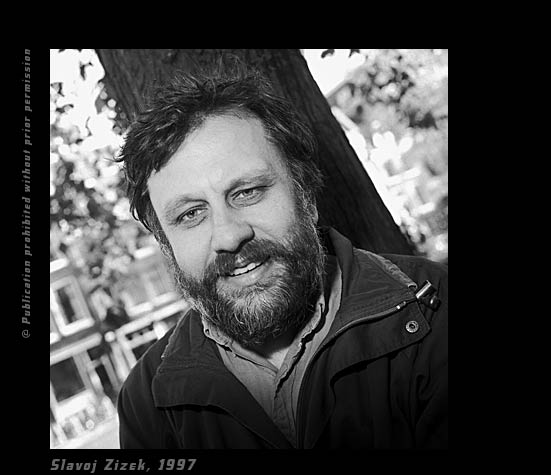
Which of these nice guys wrote the following sentence in today's New York Times" - "in Bushspeak 'modernize' is a synonym for 'privatize.' And one of the main features of the legislation was an effort to bring private-sector fragmentation and inefficiency to one of America’s most important public programs." Was it the liberal free-trader Paul Krugman? Or everyone's favorite Lacanian Leninist, the radical philosopher Slavoj Zizek?

Yes, you guessed from this set-up that the very eloquent blast at private-sector capitalism came this morning from Times regular Krugman. Zizek wrote the top op-ed piece, however, taking up half the page above the fold. He said what he always says: freedom is slavery, desire is domination, and black is white. So he shows that Jeanne Kirkpatrick's definition of totalitarian states actually applies to the United States (ideology overcoming pragmatism). OK, fine, very ironic. Like we hadn't noticed the authoritarian strain in the Bush administration - oops, I mean totalitarian. The fact that I am thinking about these two words together makes me believe that Zizek is as much a creature of the Cold War as is Cheney, but that's a cheap shot so I'll get back to my point.

The walk around the block doesn't work so well this time, but it does show Zizek at home in his middle-class habitat. His tag line comes from Saddam's pre-war spokesperson, who said, as the Americans invaded, "They are not in control of anything — they don’t even control themselves!” This allows Zizek to conclude as follows: "And now the United States is continuing, through other means, this greatest crime of Saddam Hussein: his never-ending attempt to topple the Iranian government. This is the price you have to pay when the struggle against the enemies is the struggle against the evil ghosts in your own closet: you don’t even control yourself." 

Really?  The US invaded and occupies Iraq and threatens Iran because Bush doesn't control himself? Or Cheney? Actually they control themselves quite well - well enough to ignore any and all facts that conflict with their quite clearly formulated goals. One of their goals is to control the Middle East, its politics and its resources. Bush et al. also control the state and the military, and two branches of the federal government (and still control the Congressional agenda even as the Lapdog Party gets to sit in the big chair for a while). Since Iran is in the way, Iran must be pushed aside somehow. Bush isn't struggling against his evil ghosts, he's struggling against the power of Iran.

Zizek's analysis reproduces middle-class Americanism in three ways. First, it makes the country's will to power over most of the world into an internal psychodrama, "An American Dilemma" in which we wrestle with our good and bad impulses. Second, he reproduces the suburbs' belief in our own basic innocence: he sidesteps the real story, which is that we avert our eyes from the consequences for others while voting for our financial and political interests as they are being protected in Iraq. These are the maintenance of the great and unearned wealth disparity for all of us ordinary American middle-class folks who aren't really better than our Indian or Filipino counterparts who do the same work for a tenth of the pay. Did we all vote for Bush, and then vote for him again, , by mistake? Because we couldn't control ourselves? Because we were controlled by evil elements in our unconscious? Third, Zizek enforces that middle-class truism that the system really isn't controllable and therefore there's nothing for us to do. A radical epistemology of inevitable misrecognition is the identical twin of suburban complacency. "We're all totalitarians now" is the Zizekian Call of the Mall.

Zizek made more sense in the first years after the collapse of the Soviet Union, when ethnic difference was being manipulated by nationalists into dirty civil wars.  He furnished a superb one-line explanation for how people could be made to kill their unoffending long-term neighbors: "you, newly-identified as Other, have stolen my enjoyment." 

People fight, Zizek explained, to preserve the illusion that they had some enjoyment to lose and that they didn't kill it on their own. As we saw in yesterday's posting, they will accept a self-designated Good Shepherd who kills people so they don't have to face that a) their enjoyment is gone and that b) they got rid of it themselves by putting other things first, like their money and their control. 

But at some point, Zizek forgot that the problem in the West is too much control and not too little. I think race flipped him out - his mid-to-late 1990s diatribes against multiculturalism as pure market ideology are wrong but symptomatic of an academic middle-class that deep down didn't want to share power with brilliant newcomers from "other" cultures in the US and the rest of the world. In any case, he got stuck in his "things are really their opposite" doggie show. Multiculturalism is capitalist consumption, and democracy is totalitarianism, and the Bush administration doesn't control itself. 

These tricks mean that Zizek can always stay one step ahead of people with substantive knowledge or socio-cultural experience of which he is wholly ignorant. He always already knows, and retains his analytic priority to everyone else. Different or alien knowledge and political programs are self-preempting, and this is a perfect display of the political passivity that serves the gated communities.

Good ol capitalist Krugman is the one who says, on the same page, that public services are often more efficient that private ones - that the capitalist fix of society is frequently a lie. Is this really less radical than Zizek? Academia - like the US in general - should be much clearer about what is radical and what is not. And when it is it will be less paralytically middle class.

Thursday, January 04, 2007

Little Shepherds

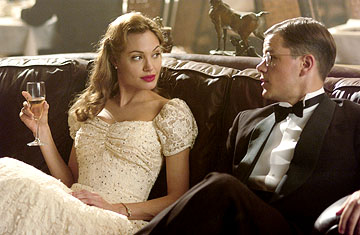
Here are Matt Damon and John Tuturro, good Company men who just blew the Bay of Pigs operation, taken from "The Good Shepherd." Unfortunately, the film itself was a snooze-fest about the empty WASPs who ran an empty US foreign policy. I stayed awake so as not to offend my pal Rebecca who took me to it, and entertained myself by wondering if the film was cleverly thematizing boring emptiness or just being boring and empty without meaning to. Sadly, there were no other signs of cleverness in the film, just ghosts of two decent ideas. One was about the effects of this post-war emptiness at the top of US society -that the deadliness of the US in the Cold War came less from necessary responses to real threats than from our own leaders' emotional exhaustion and intellectual emptiness (the USSR military is described as a sham by one would-be defector our hero Matt Damon has been busy torturing). This idea is like an object in one of the photos the techie spooks analyze that you can infer but never actually see. The second ghost of an idea came from my pal Rebecca, who recalled the film's only good line. Italian mobster Joe Pesci names a few things different US ethnic groups have and then asks the typically silent and inert Damon, "what do you people have"? "We have the United States of America," Damon replies. "The rest of you are just visiting." Rebecca said that this could have been a movie about the CIA as an agent of white supremacy. True, but it was just ghost #2.

Some IMDb reviewers have complained about Jolie's performance, among others. I don't think any of the performances are bad as such - Jolie's is technically quite good - but there IS something wrong with the characters and their interactions. The film plays like a group vanity project in which De Niro and crew put on an extra-long after-dinner skit for their wealthy liberal friends. They know things have gone bad in America, they don't like American foreign policy and all the dirty tricks and killing. But they don't know what went wrong, or why, or what to do about it. They especially don't think that they benefit from any of this killing - that the CIA has been quite handy at giving the U.S., a declining manufacturing and increasingly corrupt power, unfair advantages in the world, advantages that in turn lead to Hollywood and Wall Street's ridiculous wealth. Could part of America's problem be exactly this kind of mental passivity and actual indifference to democracy among the most privileged members of the middle class? Gosh! It raises a question I sometimes blog about on these very pages - did we long ago trade in democracy and camaraderie with the rest of the world for the sake of unearned, coerced global privileges? Just like Damon's character, the movie isn't self-aware enough to ask any questions like this, and the result is boredeom - theirs and ours - all the big implications and feelings gone missing.