I'd almost forgotten what a dunce David Schoolboy Brooks is because I never read him anymore, but this terrible piece was somehow unavoidable. In it, Schoolboy offers no actual argument for escalating in Afghanistan. He just refers to unnamed gladiators like himself to taunt and bully Obama with that great question of modern statecraft: "are you man enough to go to war"?
Glenn Greenwald has previously sent Schoolboy to the corner for chest-beating in class. He does it again this time (as does Amy Davidson at the New Yorker), so I'm reluctant to mention the man again. The problem is that Schoolboy spent the Bush years not only defending all pointless invasions but also establishing himself as the national spokesperson for middle-class values. In other words, he has specialized in defining extreme right-wing positions - particularly military conflict-resolution and economic plutocracy - as the foundation of bourgeois utopia.
A few people call Schoolboy on this publicly, and Greenwald is exemplary in railing tirelessly against the weird, myopic hypocrisy of media and political elites who are happy to spend money we don't have for war but not for health care. To me they sound like the clueless leaders of France during Napoleon III's mid-19th century Second Empire, a period when France should have been democratizing and developing its social capacities for various kinds of economic and social development, and when it instead became increasingly militaristic and economically second-rate. Schoolboy's term "tenacity" accidentally invoked not Churchill but Nixon in Vietnam. The middle-class lets people like Brooks speak for it only at its own mortal peril.
Schoolboy published the day after his own paper shone yet another light into the cesspool of Afghan leadership with a story revealing that Ahmed Wali Karzai, already suspected of being a major opium trafficker, is a CIA operative who helps them run a paramilitary force in Kahdahar province. The past couple of weeks have seen increasing exposure of Afghan and "AfPak" reality, including Jane Mayer's report that the CIA is also running a U.S. drone campaign in Pakistan (see also UN Special Rapporteur Philip Alston), Secretary of State Hilary Clinton's unpopular visit to Pakistan, marked by the market bombing in Peshawar (and Clinton pushing "the button on a computer that randomly chose more than 700 lottery winners"), and the U.S. visit of Afghan democracy activist Malalai Joya, whose book, A Woman Among Warlords, is a reminder of the costs of the real-world version of the armchair warlord schoolboys.
Showing posts with label elite worldview. Show all posts
Showing posts with label elite worldview. Show all posts
Sunday, November 01, 2009


Sunday, April 06, 2008
Planet Boardroom
 One of the pillars of the middle- class view is that we are not only the industrious but the represen- tative class. America R Us, and that means that elites with far more money and influence than your average teacher, accountant or internist nonetheless see things as we do.
This is a crippling delusion, since it allows the middle class to hand over its interests to whomever is in charge, e.g give up health care to HMOs, public universities to Republican state-funding cutters, tax policy to hedge-fund lobbyists. But if you still believe it then we have evidence you can use to retrain your senseless reflexes.
As the papers announced on Friday that the US economy has lost jobs for the third month in a row (80,000 more), and across a range of sectors, the NY Times published a poll showing that 81 percent of the public things the country is on the wrong track. 81 percent is an amazingly high number.
The same issue featured a business page story about all the CEOs who bought new penthouses in Manhattan while the banking system unwound.
In January, Lloyd C. Blankfein, chief executive of Goldman Sachs, closed on a $26 million duplex at 15 Central Park West, one of Manhattan’s hottest new buildings. Scott A. Bommer, a hedge fund manager, bought a Fifth Avenue co-op for $46 million. And Edgar Bronfman Jr., part of a private equity consortium that owns the Warner Music Group, spent $19.5 million for his own Fifth Avenue co-op.This is as investment bank revenue fell 45 percent industrywide during the first quarter - or worse. "James E. Cayne’s $28 million purchase of two units in the Plaza was not the biggest deal, but it was among the most awkwardly timed. A few weeks after the second deal closed, the Wall Street firm where he is chairman, Bear Stearns, collapsed."
Investment moguls are not only out of touch with ordinary reality: they're out of touch with the strange world of their own industries.
More evidence of clueless leaders:
- as the economy went down down down, executive pay went up up up. ("According to the Congressional Research Service, average pay for chief executives stood at 179 times average worker pay in 2005, up from a multiple of 90 in 1994. Adjusted for inflation, average worker pay rose by a total of only 8 percent from 1995 to 2005; median pay for chief executives at the 350 largest companies rose 150 percent.")
- the executive compensation game shows the huge personal paydays that come from nepotism and insularity.
- details of the Bear Stearns deal
- coverage of Senate hearings, where Sen Christopher Dodd, recipient of great Bear Stearns largess, seemed especially interested in whether the government forced too low a price on the hapless victim investment bank.
-a column arguing that regulators still aren't admitting any mistakes in letting the banking system get so opaque and overleveraged that "a 'well-capitalized company' [Bear Stearns] could not find anyone willing to lend it money without government help."
- a piece on subprimes showing that most lenders weren't exactly defrauded by false claims by borrowers, because they didn't exactly check up on them. The author, Gretchen Morgenson, asks this question about our Head Geniuses In Charge:
Can investors stuck with losses on these loans sue to recover their investments based on this due-diligence failure? After all, mortgage originators made representations and warranties to investors that the quality of these loans was good when it clearly was not. And they made these representations knowing that they had not bothered to conduct quick and easy borrower-income checks.Hey - maybe a national lawsuit will wake up the boss. Let's try it and see!
Meanwhile, check out the toxic buildup coast to coast.

Friday, January 05, 2007
Zizek, Philosopher of the Suburbs
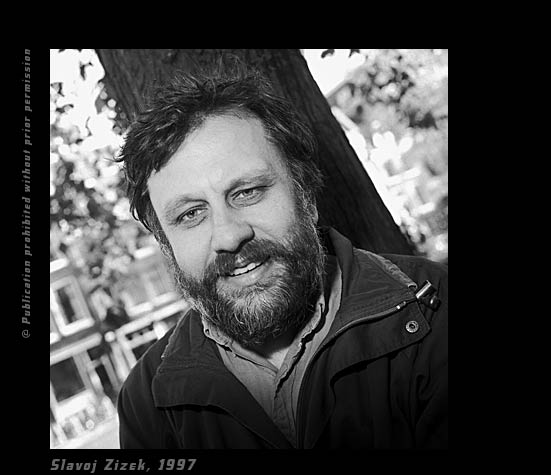

Which of these nice guys wrote the following sentence in today's New York Times" - "in Bushspeak 'modernize' is a synonym for 'privatize.' And one of the main features of the legislation was an effort to bring private-sector fragmentation and inefficiency to one of America’s most important public programs." Was it the liberal free-trader Paul Krugman? Or everyone's favorite Lacanian Leninist, the radical philosopher Slavoj Zizek?
Yes, you guessed from this set-up that the very eloquent blast at private-sector capitalism came this morning from Times regular Krugman. Zizek wrote the top op-ed piece, however, taking up half the page above the fold. He said what he always says: freedom is slavery, desire is domination, and black is white. So he shows that Jeanne Kirkpatrick's definition of totalitarian states actually applies to the United States (ideology overcoming pragmatism). OK, fine, very ironic. Like we hadn't noticed the authoritarian strain in the Bush administration - oops, I mean totalitarian. The fact that I am thinking about these two words together makes me believe that Zizek is as much a creature of the Cold War as is Cheney, but that's a cheap shot so I'll get back to my point.
The walk around the block doesn't work so well this time, but it does show Zizek at home in his middle-class habitat. His tag line comes from Saddam's pre-war spokesperson, who said, as the Americans invaded, "They are not in control of anything — they don’t even control themselves!” This allows Zizek to conclude as follows: "And now the United States is continuing, through other means, this greatest crime of Saddam Hussein: his never-ending attempt to topple the Iranian government. This is the price you have to pay when the struggle against the enemies is the struggle against the evil ghosts in your own closet: you don’t even control yourself."
Really? The US invaded and occupies Iraq and threatens Iran because Bush doesn't control himself? Or Cheney? Actually they control themselves quite well - well enough to ignore any and all facts that conflict with their quite clearly formulated goals. One of their goals is to control the Middle East, its politics and its resources. Bush et al. also control the state and the military, and two branches of the federal government (and still control the Congressional agenda even as the Lapdog Party gets to sit in the big chair for a while). Since Iran is in the way, Iran must be pushed aside somehow. Bush isn't struggling against his evil ghosts, he's struggling against the power of Iran.
Zizek's analysis reproduces middle-class Americanism in three ways. First, it makes the country's will to power over most of the world into an internal psychodrama, "An American Dilemma" in which we wrestle with our good and bad impulses. Second, he reproduces the suburbs' belief in our own basic innocence: he sidesteps the real story, which is that we avert our eyes from the consequences for others while voting for our financial and political interests as they are being protected in Iraq. These are the maintenance of the great and unearned wealth disparity for all of us ordinary American middle-class folks who aren't really better than our Indian or Filipino counterparts who do the same work for a tenth of the pay. Did we all vote for Bush, and then vote for him again, , by mistake? Because we couldn't control ourselves? Because we were controlled by evil elements in our unconscious? Third, Zizek enforces that middle-class truism that the system really isn't controllable and therefore there's nothing for us to do. A radical epistemology of inevitable misrecognition is the identical twin of suburban complacency. "We're all totalitarians now" is the Zizekian Call of the Mall.
Zizek made more sense in the first years after the collapse of the Soviet Union, when ethnic difference was being manipulated by nationalists into dirty civil wars. He furnished a superb one-line explanation for how people could be made to kill their unoffending long-term neighbors: "you, newly-identified as Other, have stolen my enjoyment."
Zizek's analysis reproduces middle-class Americanism in three ways. First, it makes the country's will to power over most of the world into an internal psychodrama, "An American Dilemma" in which we wrestle with our good and bad impulses. Second, he reproduces the suburbs' belief in our own basic innocence: he sidesteps the real story, which is that we avert our eyes from the consequences for others while voting for our financial and political interests as they are being protected in Iraq. These are the maintenance of the great and unearned wealth disparity for all of us ordinary American middle-class folks who aren't really better than our Indian or Filipino counterparts who do the same work for a tenth of the pay. Did we all vote for Bush, and then vote for him again, , by mistake? Because we couldn't control ourselves? Because we were controlled by evil elements in our unconscious? Third, Zizek enforces that middle-class truism that the system really isn't controllable and therefore there's nothing for us to do. A radical epistemology of inevitable misrecognition is the identical twin of suburban complacency. "We're all totalitarians now" is the Zizekian Call of the Mall.
Zizek made more sense in the first years after the collapse of the Soviet Union, when ethnic difference was being manipulated by nationalists into dirty civil wars. He furnished a superb one-line explanation for how people could be made to kill their unoffending long-term neighbors: "you, newly-identified as Other, have stolen my enjoyment."
People fight, Zizek explained, to preserve the illusion that they had some enjoyment to lose and that they didn't kill it on their own. As we saw in yesterday's posting, they will accept a self-designated Good Shepherd who kills people so they don't have to face that a) their enjoyment is gone and that b) they got rid of it themselves by putting other things first, like their money and their control.
But at some point, Zizek forgot that the problem in the West is too much control and not too little. I think race flipped him out - his mid-to-late 1990s diatribes against multiculturalism as pure market ideology are wrong but symptomatic of an academic middle-class that deep down didn't want to share power with brilliant newcomers from "other" cultures in the US and the rest of the world. In any case, he got stuck in his "things are really their opposite" doggie show. Multiculturalism is capitalist consumption, and democracy is totalitarianism, and the Bush administration doesn't control itself.
These tricks mean that Zizek can always stay one step ahead of people with substantive knowledge or socio-cultural experience of which he is wholly ignorant. He always already knows, and retains his analytic priority to everyone else. Different or alien knowledge and political programs are self-preempting, and this is a perfect display of the political passivity that serves the gated communities.
Good ol capitalist Krugman is the one who says, on the same page, that public services are often more efficient that private ones - that the capitalist fix of society is frequently a lie. Is this really less radical than Zizek? Academia - like the US in general - should be much clearer about what is radical and what is not. And when it is it will be less paralytically middle class.
Good ol capitalist Krugman is the one who says, on the same page, that public services are often more efficient that private ones - that the capitalist fix of society is frequently a lie. Is this really less radical than Zizek? Academia - like the US in general - should be much clearer about what is radical and what is not. And when it is it will be less paralytically middle class.
Subscribe to:
Posts (Atom)