Showing posts with label culture war. Show all posts

Sunday, October 02, 2016

Trump's Noir Power

This piece blames the Democrats for the persistence of Trump. My reason is that Trump wields what I'll call the power of noir, and the mainstream Democrats are unable to fight it.  Noir is a vision of terrible trouble and of violent recovery that in this election mixes authoritarianism, economic pessimism and racial fear (of white weakness, rather than certainty of white supremacism).  In the U.S., noir always beats nothing.  And that, at the moment, is what the Dems are offering--the status quo, no change, nothing, nothing that we don't already have with Obama, and that is clearly not enough.

This was Clinton's weakness in the debate she won.  The first question noted that half of all Americans live paycheck to paycheck and asked how the candidates would create good jobs.  Clinton answered that this is an opportunity to think about the country we want, mentioned her two-year-old granddaughter, said "I want us to invest in you," called for more profit-sharing, and said she supported better work-life balance.  All very nice.  None of them offer a direct means of restoring middle-class jobs.

Here's Trump.
Our jobs are fleeing the country. They're going to Mexico. They're going to many other countries. You look at what China is doing to our country in terms of making our product. They're devaluing their currency, and there's nobody in our government to fight them. And we have a very good fight. And we have a winning fight. Because they're using our country as a piggy bank to rebuild China, and many other countries are doing the same thing.
So we're losing our good jobs, so many of them. When you look at what's happening in Mexico, a friend of mine who builds plants said it's the eighth wonder of the world. They're building some of the biggest plants anywhere in the world, some of the most sophisticated, some of the best plants. With the United States, as he said, not so much.
So Ford is leaving. You see that, their small car division leaving. Thousands of jobs leaving Michigan, leaving Ohio. They're all leaving. And we can't allow it to happen anymore. As far as child care is concerned and so many other things, I think Hillary and I agree on that. We probably disagree a little bit as to numbers and amounts and what we're going to do, but perhaps we'll be talking about that later.
But we have to stop our jobs from being stolen from us. 
Trump said, of course we need child care.  But we're talking about other countries stealing our jobs. He offered a direct cause for job loss: other countries are getting our jobs.  He then turned to two direct solutions:
All you have to do is take a look at Carrier air conditioning in Indianapolis. They left -- fired 1,400 people. They're going to Mexico. So many hundreds and hundreds of companies are doing this.
We cannot let it happen. Under my plan, I'll be reducing taxes tremendously, from 35 percent to 15 percent for companies, small and big businesses. That's going to be a job creator like we haven't seen since Ronald Reagan. It's going to be a beautiful thing to watch.

 Trump's first direct solution helped caused the problem he laments: Reaganite deregulation allowed companies to offshore production with no financial penalties. It's a terrible solution, and will in fact make the problem worse. But he did offer a direct response to the problem, and scores points for that.  He then offered a better, second response:
The first thing you do is don't let the jobs leave. The companies are leaving. I could name, I mean, there are thousands of them. . . . And what you do is you say, fine, you want to go to Mexico or some other country, good luck. We wish you a lot of luck. But if you think you're going to make your air conditioners or your cars or your cookies or whatever you make and bring them into our country without a tax, you're wrong. 
And once you say you're going to have to tax them coming in, and our politicians never do this, because they have special interests and the special interests want those companies to leave, because in many cases, they own the companies. So what I'm saying is, we can stop them from leaving. We have to stop them from leaving. And that's a big, big factor.
This is Trump's best line, and it's straight noir.  "Big people are screwing you.  They have to be made to stop. I will stop them.  I will charge them to leave, and that will make them stop."

How did Clinton respond? By recalling the financial crisis eight years ago, and saying this:
That was in large part because of tax policies that slashed taxes on the wealthy, failed to invest in the middle class, took their eyes off of Wall Street, and created a perfect storm.
In fact, Donald was one of the people who rooted for the housing crisis. He said, back in 2006, "Gee, I hope it does collapse, because then I can go in and buy some and make some money." Well, it did collapse.
TRUMP: That's called business, by the way.
CLINTON: Nine million people -- nine million people lost their jobs. Five million people lost their homes. And $13 trillion in family wealth was wiped out.
Now, we have come back from that abyss. And it has not been easy. So we're now on the precipice of having a potentially much better economy, but the last thing we need to do is to go back to the policies that failed us in the first place.
Independent experts have looked at what I've proposed and looked at what Donald's proposed, and basically they've said this, that if his tax plan, which would blow up the debt by over $5 trillion and would in some instances disadvantage middle-class families compared to the wealthy, were to go into effect, we would lose 3.5 million jobs and maybe have another recession.
Clinton is basically right, but it doesn't matter.  There is no noir agent in her crisis. "Tax policies that slashed taxes on the wealthy" isn't an agent: it is an effect of some unnamed parties. How do we know she knows who they are?

Clinton needed to say this: "Donald has supported tax cuts his whole life, and is a champion tax avoider.  I mean he's the king of the legal tax dodge--at least I assume they're legal, Donald.  The congresspeople he gave money all through the 1970s and 1980s when jobs were leaving--they paid him back.  They cut his taxes and deregulated real estate and Wall Street.  When Wall Street blew up the economy with exactly the know-it-all arrogance we see Donald show, Donald and his friends make more money than ever, while his banker friends evicted you or your neighbor or your family member from your house.

She should have continued: "Donald will say, 'that's called business.'  Donald means, 'I win when you lose.'   Now he wants to take another $5 trillion away from you by depriving the government of $5 trillion more after he and his friends lost $13 trillion in family wealth.  He wants to take another $5 trillion from schools, clinics, roads, bridges, colleges, parks, police, firefighters, everything you need for a decent life, and give it to the same wealthy people who made all the money from the crash. Made money from the crash just like Donald did.   I won't allow that.  As president, we'll put the money Donald and his rich friends took from you back into your communities and the economy."

Clinton can only fight Trump noir by writing her own noir plot and making Trump the predator.  As many a Bernie voter knows, she is probably prevented from doing this by her own alliances with Wall Street and her own distance from the working class Democrat base that, starting with the Carter and ending with the Clinton presidencies,

The Clinton-Trump exchanges I mentioned all occur in the first six pages of a forty-page debate transcript.  Clinton goes on to invoke solar energy, inviting Trump to defend another of his terrible claims, which is more oil and coal because global warming is a hoax.  Trump instead turns Clinton-Obama back into the noir villain:
TRUMP: She talks about solar panels. We invested in a solar company, our country. That was a disaster. They lost plenty of money on that one. 
Now, look, I'm a great believer in all forms of energy, but we're putting a lot of people out of work. Our energy policies are a disaster. Our country is losing so much in terms of energy, in terms of paying off our debt. You can't do what you're looking to do with $20 trillion in debt. 
The Obama administration, from the time they've come in, is over 230 years' worth of debt, and he's topped it. He's doubled it in a course of almost eight years, seven-and-a-half years, to be semi- exact. 
So I will tell you this. We have to do a much better job at keeping our jobs. And we have to do a much better job at giving companies incentives to build new companies or to expand, because they're not doing it. 
And all you have to do is look at Michigan and look at Ohio and look at all of these places where so many of their jobs and their companies are just leaving, they're gone. 
And, Hillary, I'd just ask you this. You've been doing this for 30 years. Why are you just thinking about these solutions right now? For 30 years, you've been doing it, and now you're just starting to think of solutions. 
CLINTON: Well, actually... 
TRUMP: I will bring -- excuse me. I will bring back jobs. You can't bring back jobs. 
CLINTON: Well, actually, I have thought about this quite a bit. 
TRUMP: Yeah, for 30 years. 
CLINTON: And I have -- well, not quite that long. I think my husband did a pretty good job in the 1990s. I think a lot about what worked and how we can make it work again... 
TRUMP: Well, he approved NAFTA.. (CROSSTALK) 
CLINTON: ... million new jobs, a balanced budget... 
TRUMP: He approved NAFTA, which is the single worst trade deal ever approved in this country.
Trump gets Clinton to defend NAFTA, which destroys her image as tough on Wall Street. She doesn't ever say what the great new ideas are that have come from 30 years of thought.  He goes on to point out that her own party's president is pushing a new trade deal that's like NAFTA, and she doesn't repudiate Obama.  She says, "there are different views about what's good for our country," which proves Trump's point that she can't be trusted to know who the enemy is or to do anything to that person.

When they get to the next segment on taxes, her big line is that she "would not add a penny to the debt." This puts her entirely in the camp of the conventional Republicans that Trump torpedoed in the primaries.  So it doesn't matter that Trump says "the wealthy are going to create tremendous jobs" when the wealthy have been doing the opposite for thirty years, because he is talking directly about overcoming an enemy--people who send American jobs abroad.  She is not.

In the final two-thirds of the debate, Trump lost focus and became defensive, so most pundits have declared her the victor. She was not. She didn't become a noir hero battling an identified evil with a direct intervention.  Trump remained one.

The same problem dogs today's New York Times revelation that Trump may not have paid income taxes for twenty years. Previous NYT reports have showed that Trump built much of his empire on political connections that generated $885 million in tax breaks in postindustrial New York, made his money on a labyrinth of debt, on bankruptcy, and on shorting investors he'd attracted while stiffing working-class contractors.   As U.S. manufacturing and its blue-collar workers declined, real estate deals and Trump's extractions soared.  So you'd think Clinton could make Trump the poster child of American decline, caused by its greedy extractive financiers.

Not so far.  In response, Trump said the Times is an arm of the Democratic party,  that they broke laws to get the tax documents, that Hillary Clinton is even more criminal than Trump is, that Trump is a supremely skilled businessman who was obliged to minimize his tax burden which is what he did. The crucial statement appeared in a Trump tweet: "I know our complex tax laws better than anyone who has ever run for president and am the only one who can fix them."

Translating the noir code: "I know the system, I used the system, I broke the system. If you want to fix the system, hire the person who was big enough to break it.  And if you don't, I will keep breaking it."


In a guilt-driven nation like ours, he who shows no guilt will be considered innocent, and receive a hero's welcome.  This is how we have gotten to Trump, the conquering hero.  Some analysts feel that Trump is such an obviously unqualified and corrupt candidate that it's a miracle that Hillary Clinton isn't 20 points ahead. I feel that Hillary Clinton is such a weak candidate on working-class and middle-class economics that Trump still can win. 

UPDATE: Trump's "bitchy sewing circle of overweight men" performed exactly this spin control about the NYT story today (h/t Meranze)--Trump the conquering tax hero.

Friday, December 04, 2009

Obama Kills His Better Half

Obama's decision to escalate in Afghanistan was sad and stupid, and made stupider by the bollocks he talked in justifying the dumb murderous thing.

There was
  • "the waving of the bloody shirt" - the oldest presidential gesture in US histor - around  9/11. 
  • the repetition of Bush's fradulent claims of The Terrorists' immediate threats to American security.
  • the phallic backdrop of West Point, the martial imagery, the sentimental militarism, the "using [of]American soldiers as props" by yet another president who feels insuffficiently martial for warrior nation, the grotesque ass-kissing - "it's an extraordinary honor for me to do so here at West Point" - hello, you're the elected president, we still have a civilian government don't we?
  • the standard self-righteous vision of America's own saintly and hence preeminent leadership in all actions, thanks to its absolute innocence of selfish motives behind violent acts ("unlike the great powers of old, we have not sought world domination"). 
  • no recognition of the failure and uncertainty of military interventions (cf Bacevich)
  • no recongition of the absurd double standard of the US military presence in 130 or more countries - you must check with us about everything; we do whatever we want
  • no recognition of blowback (Reuters found multiple expressions among Afghans within a few minutes of the speech's end)
  • no recognition that the US, in escalating its occupation of a Muslim country, is doing exactly what a credible authority named Osama bin-Laden said provoked terror in the first place - occupying a Muslim country
  • no ability to see that 130,000 US troups in a country is an occupation. For god's sake.
  • no recognition of the mindless destructive waste, the death trip, the death drive.
  • no recognition that noone in other countries believes any of this bullshit - strictly no one, none of it, especially not the pathetic washing of the blood off the hands at every public opportunity as though the whole world were a fundamentalist church.
Aside from the futility of the policy itself (see the whole Democracy Now broadcast December 2 for the many reasons why), it's also finished for Obama - he's cooked his own goose.

Historical evidence for this unpleasant conclusion was nicely condensed by Rep. David Obey in his honorable attempt to impose an Afghan wartax (squashed by House Speaker Nancy Pelosi):
if we don’t pay for it, then the the costs of the Afghan war will wipe out every other initiative that we have to have to rebuild our economy. That’s what happened with the Vietnam War which wiped out the Great Society. That’s what happened with the Korea War that wiped out Harry Truman’s Square Deal. That’s what happened to the progressive movement back before the 20s when we went into World War I. In each case costs of those wars shut off the ability to afford anything else.”
Obama has deliberately embraced the wiping out of his own domestic policy. And that is what he will get.

Obama is going down.  During our latest undeserved ordeal, try at least to enjoy Onion stories about our most recent Teleprompter President. The big question remains:  how will we avoid going down with him?

Sunday, August 09, 2009

Dumb Enough Yet?

Bill Mahler has been working the theme that this is a dumb country. This obscure blog can hardly disagree.
And before I go about demonstrating how, sadly, easy it is to prove the dumbness dragging down our country, let me just say that ignorance has life and death consequences. On the eve of the Iraq War, 69% of Americans thought Saddam Hussein was personally involved in 9/11. Four years later, 34% still did. Or take the health care debate we're presently having: members of Congress have recessed now so they can go home and "listen to their constituents." An urge they should resist because their constituents don't know anything. At a recent town-hall meeting in South Carolina, a man stood up and told his Congressman to "keep your government hands off my Medicare," which is kind of like driving cross country to protest highways.
I'm the bad guy for saying it's a stupid country, yet polls show that a majority of Americans cannot name a single branch of government, or explain what the Bill of Rights is. 24% could not name the country America fought in the Revolutionary War. More than two-thirds of Americans don't know what's in Roe v. Wade. Two-thirds don't know what the Food and Drug Administration does. Some of this stuff you should be able to pick up simply by being alive.
Against this kind of evidence, I'm one of those odd people who thinks that humans are naturally smart, not dumb, and naturally goo - well not good exactly but not naturally evil. I have 20 years of students to prove limited and localized non-dumbness - smartness is possible!

But my optimism is being sorely tested by the United States of America as a whole. Of course this isn't the first time, but I was thinking that during the first summer that we have Obama rather than Bush, that the big picture might start being a little less dumb. No such luck. We're back at the level where US politics consists of Republicans making up some really dumb shit, and the media broadcasting it everywhere as a real story. Like Sarah Palin's claim that Obama health reform will mean a "death panel" that might have killed her Downs' Syndrome baby. Say anything - the dumber the better.

None of the bloviating against socialism etc was ever smart enough to defend ideas that actually worked. Floyd Norris produced some data last Friday showing that the private sector added virtually no new jobs between 1999 and 2009. The growth areas? Lawyers, accountants, and managers, who worked tirelessly to make the economy good for them. You can see how it worked out for the other 90%.

Wednesday, July 22, 2009

Class Seismic Shift in 2008 Election?

Ruy Teixeira says so in an interesting interview in 538. I don't buy the title claim for reasons I'll explain later, but there are interesting statistical trends:
  • Obama won not because white working class voters shifted towards him, but because the electorate shifted away from white working class voters (towards the college-educated middle class and people of color).
  • younger white working class voters ("Millennials," born in 1978 and after) did vote for Obama, as did their entire cohort by a huge margin of 2:1. So "help is on the way," if you care about the dumbness of white people.
  • the "country party" of rural America is as hard core conservative as ever.
Nothing about Teixeira's kind of analysis, with its "creative class" biases, will change that. These analyses have an alienating feedback effect that I wish demographers could actually take into account.

Monday, January 19, 2009

Martin Now

It's hard to believe listening to him again on the radio how precise Martin Luther King was about the problems of his day - and, sad to say, our day as well.

Problems like: "war preventing programs" - programs for every kind of social progress. At one point he quoted a US Senator's estimate that the US was spending $500,000 to kill every Vietnamese solider, but only $53 per person to end poverty in the US.

The US story then, and the US story now, is the centrality of war, the weight of war spending, and more generally the irrationally of misspending in grotesque overproportion to suppress threats when their root causes should be fixed instead.

In the 1980s and 1990s it was "wealth preventing programs" - the piling up of huge fortunes in tech and finance that avoided the root causes once again.

What is it about us that makes us unable to stop?

King was great about the psychological underpinnings of the compulsive American errors - the helpless, defiant, and yet shame-filled, and reality-denying thread of uncontrollable feeling that backed it all. He once summarized the foundations of US foreign policy, with its world-alienating use of force to back oppressors, as "this melancholy body of obsessions."

Washington won't ever stop its backward choices unless the US population makes them stop.

Thank you for the reminders, MLK. And Happy Birthday.

Monday, December 08, 2008

Pavlovian Applause

That is Fr. Frank's phrase for the fairly mindless praise being heaped on the Obama economic team, people of great credentials and many practical failures.

The piece is called "The Brightest are not Always the Best." One great thing about Frank Rich is that he's incapable of saying what everyone else is saying. But another great thing is his ability to find a cultural framework that puts politics in perspective. Here he invokes David Halberstam's book about the boy wonders in the JFK administration who brought us the quagmire of Vietnam.

Were Fr. Frank not invoking Halberstam, he could have used a more accurate title, "The Brightest are Often Dumb."

The piece is about Summers and Rubin and Geithner and you won't be surprised by the flaws he finds in their actual record. The more interesting bits are the frighteningly familiar comments from Halberstam about the blindness of the Kennedy geniuses. Since I think Kennedy is Obama's real model rather than Bill Klinton, it was alarming to hear Halberstam talk about the free pass the DC press gave JFK because of his similarties to them as to prep schools, Ivies, credentials, and white-collar world-view - a certain kind of entitled, liberal elitism that you could hear in Obama's comment as he introduced his foreign policy team: "They share my pragmatism about the use of power, and my sense of purpose about America's role as leader in the world."

Rich quotes Halberstam at one point on how the boy geniuses were not so smart:
“the difference between intelligence and wisdom, between the abstract quickness and verbal facility which the team exuded, and true wisdom, which is the product of hard-won, often bitter experience.” That difference was clearly delineated in Vietnam, where American soldiers, officials and reporters could see that the war was going badly even as McNamara brusquely wielded charts and crunched numbers to enforce his conviction that victory was assured.
This is true. The "quickness" comes from systematic dissociation from the actual consequences of and people affected by the model that appears in the boy wonder's brain.

There are two things that have made the problem much worse since Kennedy:
  • the hegemony of economics over domestic policy. Economists in the US are abstract modelers, and the modelers are in charge of Obama's economic policy.
  • the "knowledge economy" was just an idea during the Kennedy Administration, first publicized by UC President Clark Kerr as the Kennedy period was coming to an end. The prestige of "symbolic analysts" and their detachment from the great masses of real people are more acute now by a factor of 10.
It's going to take cultural imagination to get us out of this. The question is how do we get that through the airlocks of the Obama Admin?

Tuesday, June 12, 2007

Culture War Dumbness

David "Schoolboy" Brooks outdoes himself today with a particularly desparate, silly piece blaming fears of immigration on college elites. Don't ask about the logic, which would be like looking for the Sermon on the Mount in a long dribble of uncooked batter. The basic idea is that working people don't have any real economic problems after 30 years of Republican rule that has seen zero real income growth for about 80% of the population - they just don't like the liberal cosmopolitanism of college-educated elites. The essay is an aggravating five-minute escape from any known reality here on Earth One, where Schoolboy's culture-warrior pals have been helping destroy the economic base of their beloved "regular folks" while telling them their real enemies are liberals who send money to save Darfur. Gaaah!

Schoolboy's New York Times pals wrote a good editorial on Monday that he obviously didn't read. The editorial reported that accoreding to a study by Frank Levy and Peter Temin, two MIT economists, the top 1 percent of Americans (average income, $1.1 million) took almost a quarter of the nations income, "their largest share since 1929." There's a connection between the Republican's happy inequality boom and the anger of Brooks' "nationalists," which someday may finally focus on the real cause - conservative economic policies that reward the destruction of jobs.

A better account of growing inequality appeared in the same paper on Sunday. "The orthodoxy surrounding income inequality is being undermined by research that looks at institutional issues: changes in the way the corporate world measures the performance of workers, the decline of unions, and government wage and tax policy." Doh!

And for a sad tale of the king of Clintonian economics, Larry Summers, now suprised by inequality, see a short Sunday Magazine piece. "I'm finding my way," Summers says about the effects of his own policies. Far better is an interview with the producer of "Entourage," Doug Ellin, with his jaundiced desire to exploit the dumbness of Beemer lust and related more expensive desires. He doesn't make the Schoolboy mistake of confusing the desire to be rich with a noble vision for a red-state America.

Friday, June 08, 2007

Dumbness and the Fight Against It

Today's New York Times has a nice illustration of the battle for what's left of the middle-class mind. There's Paul Krugman fighting dumbness by showing how the media has turned politics into a beauty contest that prevents people from voting on the basis of issues. "listening to what candidates say about substantive issues offers a much better way to judge potential presidents than superficial character judgments. Mr. Bush's tax lies [in the 2000 campaign], not his surface amiability, were the true guide to how he would govern."

In the other corner, representing dumbness, is David "Schoolboy" Brooks, with another of his grandiloquent philosophical frameworks leading to Reaganite cliches. Painting himself as a "Hamilitonian" in an epic battle with "mainstream liberals" and populists, he concludes, "Government is really bad at rigging or softening competition. It can do some good when it helps people compete." This distinction rests on a Schoolboy contrast between job retraining, job protections, and jobs programs (where gov is bad), and portable pensions and health insurance and skill-based immigration and encouragement of marriage (where gov is good). In fact all Schoolboy does is slam programs for workers and praise programs for the middle-classes. Blue-collar is bad, white-collar is good. Programs that make blue-collar people like white-collar people are good. Schoolboy wants a world in which gated commuters are subsidized and nobody else is - a paradise of bobos, paid for by everybody else.

If we don't start catching on to this classic middle-class dumbness, were not going anywhere except down.

Which reminds me: in March I blogged about Pakistani lawyers in revolt; this past week the U.S. press has realized that the protests have spread widely enough to be threatening to the Musharraf regime.

Friday, January 05, 2007

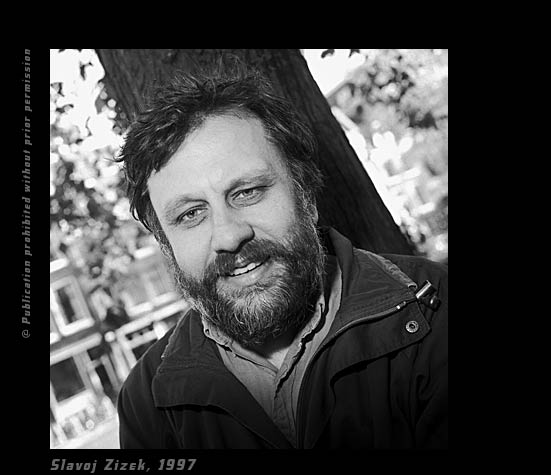
Zizek, Philosopher of the Suburbs


Which of these nice guys wrote the following sentence in today's New York Times" - "in Bushspeak 'modernize' is a synonym for 'privatize.' And one of the main features of the legislation was an effort to bring private-sector fragmentation and inefficiency to one of America’s most important public programs." Was it the liberal free-trader Paul Krugman? Or everyone's favorite Lacanian Leninist, the radical philosopher Slavoj Zizek?

Yes, you guessed from this set-up that the very eloquent blast at private-sector capitalism came this morning from Times regular Krugman. Zizek wrote the top op-ed piece, however, taking up half the page above the fold. He said what he always says: freedom is slavery, desire is domination, and black is white. So he shows that Jeanne Kirkpatrick's definition of totalitarian states actually applies to the United States (ideology overcoming pragmatism). OK, fine, very ironic. Like we hadn't noticed the authoritarian strain in the Bush administration - oops, I mean totalitarian. The fact that I am thinking about these two words together makes me believe that Zizek is as much a creature of the Cold War as is Cheney, but that's a cheap shot so I'll get back to my point.

The walk around the block doesn't work so well this time, but it does show Zizek at home in his middle-class habitat. His tag line comes from Saddam's pre-war spokesperson, who said, as the Americans invaded, "They are not in control of anything — they don’t even control themselves!” This allows Zizek to conclude as follows: "And now the United States is continuing, through other means, this greatest crime of Saddam Hussein: his never-ending attempt to topple the Iranian government. This is the price you have to pay when the struggle against the enemies is the struggle against the evil ghosts in your own closet: you don’t even control yourself." 

Really?  The US invaded and occupies Iraq and threatens Iran because Bush doesn't control himself? Or Cheney? Actually they control themselves quite well - well enough to ignore any and all facts that conflict with their quite clearly formulated goals. One of their goals is to control the Middle East, its politics and its resources. Bush et al. also control the state and the military, and two branches of the federal government (and still control the Congressional agenda even as the Lapdog Party gets to sit in the big chair for a while). Since Iran is in the way, Iran must be pushed aside somehow. Bush isn't struggling against his evil ghosts, he's struggling against the power of Iran.

Zizek's analysis reproduces middle-class Americanism in three ways. First, it makes the country's will to power over most of the world into an internal psychodrama, "An American Dilemma" in which we wrestle with our good and bad impulses. Second, he reproduces the suburbs' belief in our own basic innocence: he sidesteps the real story, which is that we avert our eyes from the consequences for others while voting for our financial and political interests as they are being protected in Iraq. These are the maintenance of the great and unearned wealth disparity for all of us ordinary American middle-class folks who aren't really better than our Indian or Filipino counterparts who do the same work for a tenth of the pay. Did we all vote for Bush, and then vote for him again, , by mistake? Because we couldn't control ourselves? Because we were controlled by evil elements in our unconscious? Third, Zizek enforces that middle-class truism that the system really isn't controllable and therefore there's nothing for us to do. A radical epistemology of inevitable misrecognition is the identical twin of suburban complacency. "We're all totalitarians now" is the Zizekian Call of the Mall.

Zizek made more sense in the first years after the collapse of the Soviet Union, when ethnic difference was being manipulated by nationalists into dirty civil wars.  He furnished a superb one-line explanation for how people could be made to kill their unoffending long-term neighbors: "you, newly-identified as Other, have stolen my enjoyment." 

People fight, Zizek explained, to preserve the illusion that they had some enjoyment to lose and that they didn't kill it on their own. As we saw in yesterday's posting, they will accept a self-designated Good Shepherd who kills people so they don't have to face that a) their enjoyment is gone and that b) they got rid of it themselves by putting other things first, like their money and their control. 

But at some point, Zizek forgot that the problem in the West is too much control and not too little. I think race flipped him out - his mid-to-late 1990s diatribes against multiculturalism as pure market ideology are wrong but symptomatic of an academic middle-class that deep down didn't want to share power with brilliant newcomers from "other" cultures in the US and the rest of the world. In any case, he got stuck in his "things are really their opposite" doggie show. Multiculturalism is capitalist consumption, and democracy is totalitarianism, and the Bush administration doesn't control itself. 

These tricks mean that Zizek can always stay one step ahead of people with substantive knowledge or socio-cultural experience of which he is wholly ignorant. He always already knows, and retains his analytic priority to everyone else. Different or alien knowledge and political programs are self-preempting, and this is a perfect display of the political passivity that serves the gated communities.

Good ol capitalist Krugman is the one who says, on the same page, that public services are often more efficient that private ones - that the capitalist fix of society is frequently a lie. Is this really less radical than Zizek? Academia - like the US in general - should be much clearer about what is radical and what is not. And when it is it will be less paralytically middle class.