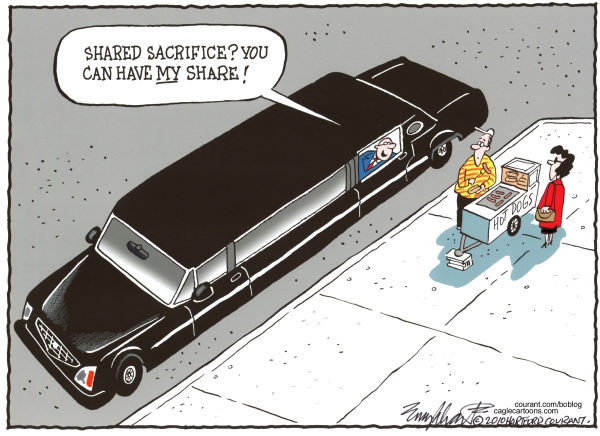
Saturday, February 11, 2012

Greco-America

My favorite Capitalist Pal, trader Phillip Lewis, has a remarkable section in yesterday's post that is worth quoting in full.  Are European leaders going to force Greece to go the way of Russia under Yelstin, in which public health falls off the cliff?  It's another omen of a new dark age.  The deep psychological question is why elites are ok pushing things this way.  As Davis points out, they can't save themselves either.

****  Davis follows:

Sunday, January 08, 2012

How Subsidized Capitalism Hurts Innovation

Last week I posted on our more active university blog about how subsidized capitalism damages both the funding and popular understanding of the central role of public services in building economies and societies.

The post was just a first poke for the new year into a huge hole in Anglo-American capitalism's theory of itself.  This theory ignores the extent to which it has spent the conservative 1980-2010 period absorbing public resources into its own revenues. Most of this theory's public apologists denounce public spending, which has helped massively reduce their tax obligations -- tax avoidance has become a major profit strategy -- while justifying private appropriation as putting public money to better use.

The New York Times has a good example of the problem.  Caterpillar is spending $426 million building a new factory in North Carolina.  It has gotten the state to pay $51 million in various incentives, including $5.3 million in direct costs to train future Caterpillar workers.  Since most of the training is being done by a local college called Forsyth Tech, the state is footing other costs as well.

This suggests serious weakness in the economic theory itself.  The co-founder and longtime CEO of Intel, Andy Grove, wrote a while back that "the U.S. has become wildly inefficient at creating American tech jobs." Intel spent $3600 in adjusted dollars for every job it had 10 years after its founding.  This cost has exploded to $100,000 per job at some of the country's most successful high-tech companies -- Genentech, Google, etc. Here's the chart that accompanied the article:


The cost of each new Caterpillar job in North Carolina is $130,000 - well above Google's cost.  But that is only the state of North Carolina's contribution.  Add in the company's own investment in the new facility, and you get an incredible $1.2 million per job.  Caterpillar is very inefficient at creating jobs, and has gotten North Carolina to pick up some of the excess cost.

The use of the chart above isn't entirely fair, since the 392 jobs is this Caterpillar plant's immediate workforce and not the workforce 10 years out.  But the point of the new plant is to use technology to suppress workforce growth, suggesting future growth will be limited. And the huge cost per job can only be justified, if at all, through some extraordinary and unlikely tech-fueled level of productivity.  These are not obviously sustainable jobs, and the article points out that some of the same workers in the new state training program have been burned before by hit-and-run companies.

The problem with the expected public subsidy of capitalism has several parts. The first is that U.S. federalism has put states and local jurisdictions in competition in a "race to the bottom" to offer the weakest union protects, weakest safety requirements, lowest wages, and highest subsidies. Yes there are practical limits to all this and no not all firms are slave-driving exploiters of labor and plunderers of the public purse.  But the downward spiral is the logic of the system, and a well-paying company with good labor conditions (that support creativity) in New Jersey or Minnesota is vulnerable to competition from cheap operators in states like, well, North Carolina.

The second problem is deeper, and Andy Grove points it out.  U.S. companies are less efficient at creating jobs, he says, because the country has spent the last few decades shipping manufacturing know-how overseas, attached to the jobs it has shipped over there.  Grove focuses on the capacity for "scaling," which is the way that a good invention becomes an industry that supports lots of employment. The million little problems that must be solved require complex knowhow that is housed in people. Solutions require an entire, "effective ecosystem in which technology knowhow accumulates, experience builds on experience, and close relationships develop between supplier and customer." When this ecosystem is already established as it famously is in a place like Silicon Valley, new jobs are generally less expensive to create.  When you don't have that ecosystem, they cost a lot and, just as importantly, they are less secure.

Universities are central to an innovation ecosystem, and constantly cutting their budgets weakens the ecosystem as a whole.  But interestingly, cuts ironically drive up the cost of new jobs rather than lowering them (usually defined as lower taxes).   A weaker innovation ecosystem can destroy a new industry before it gets started.  Grove's example is lithium-ion batteries for the next generation of electric cars and trucks.
The U.S. lost its lead in batteries 30 years ago when it stopped making consumer electronics devices. Whoever made batteries then gained the exposure and relationships needed to learn to supply batteries for the more demanding laptop PC market, and after that, for the even more demanding automobile market. U.S. companies did not participate in the first phase and consequently were not in the running for all that followed. I doubt they will ever catch up. 
Subsidized capitalism conceals the real problem, which is the weakening of the overall social environment in which innovation and sustainability take place.   It has been weakened by social underinvestment.   Grove calls explicitly for jobs policy -- for "jobs-centric" leadership.

We won't get something that intelligent because both parties like to shovel public money toward private firms, even when it means taking public funds away from the social ecosystem on which the firms depend.

To wrap up, subsidized capitalism kills two birds with its one big stone.  First, it hurts public services. Subsidized capitalism has enabled the takeover of the charter school movement by education companies whose existence depends entirely on taxpayer funding.  The same goes for-profit university-company sector, which depends so totally on federal loan money that it pipes through its student-customers that the government has had to cap their receipt of federal funds as a share of total revenues at 90%.  This sector sells educational services, but makes its money by not spending revenues on education, and produces bad educational results.  The bad drives out the good, as the for-profit sector's existence convinces many policymakers that they can get away with spending less public money on real-thing public education.   The same has happened to transportation. A somewhat funny example is Chicago outsourcing its parking meters, which historically helped pay for street improvements.  More seriously, the UK House of Commons's Treasury Committee published a study last August, 20 years into its "Private Finance Initiatives" experience that included privatizing its rail system.  The committee found among other things that PFI deals typically added 40% to the service costs.

The second victim of subsidized capitalism is the private sector itself.  Demanding tax reduction with one hand and receiving taxpayer funding with the other, corporate America has ignored the role of public funding in building the advanced society on which its own survival depends.  After nearly 40 years of this, in 2012, it's not clear that the U.S. will ever catch up.

Wednesday, November 02, 2011

Democracy vs. Finance Capitalism: Greece and Solar

Hat tip to Brad for the headline that summarizes the whole "problem" created by the Greek government putting the Poverty Now plan-of-the-week to save-punish Greece to an actual vote:  "Democracy Wipes Out Gains for Stocks."

A nice analysis comes from Yves Smith on the "debtor that roared."  The rescue was only going to accomplish the continuing impoverishment of the Greek population without actually stabilizing the banking system, and forget about inspiring investment and recovery.

Thinking about the examples of recoveries in places as different as Argentina (early 2000s) and Signapore (late 1990s), it would be interesting to imagine an actually democratic alternative to the financial system we have now. The minimum elements would be much smaller banks and regulation around lending that would push them close enough to local needs for investment capital that it would be more straightforward to nationalize them.

Wednesday, October 12, 2011

Wall Street Dissidents Backstop the Occupation

A crucial development in 2011 has been the way the Wall Street has managed to alienate so many of its natural supporters among economists, top economic journalists, and financial professionals.

Lots of mainstream finance commentators finally went ballistic over the state of financial policy.  The most interesting group are the professional investors who have turned on their masters. I get to them at the end of the list of dissidents.

The Angry KeynesiansPaul Krugman is Exhibit A, a 1990s liberal free-trader where strong state intervention was the exception more than the rule, but who opposed the Bush tax cuts and for the ten years since has railed tirelessly about every replay of deregulatory trickle-down business-led plutonomics. He summarized the Bush Years as "The Big Zero,"   denounces  "The Austerity Delusion,"  "The Urge to Purge,"   "Cockroach Ideas," among many others.   The "Economic Bleeding Cure" is a classic of this genre.
Fortunately, physicians no longer believe that bleeding the sick will make them healthy. Unfortunately, many of the makers of economic policy still do. And economic bloodletting isn’t just inflicting vast pain; it’s starting to undermine our long-run growth prospects.
Keynesians care about the development of society, and are confused and enraged by the casual blowing off of these concerns by policymakers in the US and the EU alike.  "Well, this is a miserable step in the wrong direction" says  Jeffrey Sachs, starting a denunciation of both parties in the US.  "From a self-preservation angle, this is lunacy," notes David Dayen.  

Nicholas Kristof alienated some Occupier supporters with a somewhat patronizing attempt to suggest demands, but he is also the author of the excellent summation "Our Banana Republic," voicing anger at policy suports for social devolution.  But you know these people.


Prophetic Re-regulators This group consists of high-end experts in technical domains -- mortgage industry regulation, complex credit instruments, international banking relationshiops -- who have become relentless and sometimes furious bloggers. They focus on the non-improvement of the financial system itself -- not so much on its social effects as its continuing rottenness, now propped by massive government subsidies (a 0.16% interbank funds rate for example) and complicity in the perpetuation of the shadow banking system that caused the problem in the first place.  You know most of these folks too:  the sober Simon Johnson and James Kwak at the Baseline Scenario, Dayen on housing, and Yves Smith at the remarkable Naked Capitalism on housing, banking as a criminal enterprise, and idiotic political dynamics that are forcing a choice between shooting the economy (Republicans) or bleeding it to death (Dems).  

Cassandras of Systemic Failure.  The lead people here are in Europe, with Martin Wolf at the front of the pack. These are a mixture of journalists and economists who accept the need for "adjustment" of the most crisis-ridden economies -- read drastically lowered living standards for the 99 percent -- but think politicians aren't being smart or independent enough to manage even that.  Wolf recently predicted a lost decade unless governments simply cranked up the printing press and created money, denouncing sadism towards populations along the way. He often points out that economic failure was not caused by bad behavior but by not very enlightened market judgements, e.g. public debt burdens that were lower in Ireland and Spain than in France and Germany.  This is the Japan Syndrome writ large by pro-capitalists who see that financial corruption and momentum have undermined the systems that made capitalism stable for a while.

Raging Traders. These are working investors, many of whom write blogs to attract customers to their investment business, which often consists of selling their trading advice.  Post-facto posts are the sign over the entrance meant to encourage signing up for the live action inside the tent.   These people trade every day,  feel shafted and betrayed, and are absolutely furious.

Here's the boss of Phil's Stock World on the horn last December talking about Obama's capitulation on the tax cut extensions.  Remember, Phil likes numbers.


Good job Congress!
Way to take it from your new Republican Masters! Not since Jack sold his cow for some magic beans has a deal like this been made by our "leadership" where families earning between $35,000 and $64,000 go $7,800 further into debt to get a $613 tax break while families earning between $5M and $10M get $38,590 and families earning $50M to $100M get $380,590 and families (or Corporations, of course) earning $500M to $1Bn get $3,859,000 or about 12,590 times more than the average middle class family but, then again, they deserve it because – they are that much better than you are!

Face it, unless you are in an income category where your tax benefit has 5 digits, you are what George Orwell (who worked in England’s Ministry of Propaganda) called a "Prole." In 1984 the Proles (proletariat) were the vast majority of the populace, the working class of Oceana. Though the proles are the majority, they are unimportant. The Party explicitly teaches that the Proles are "natural inferiors who must be kept in subjection, like animals". As one of the Party Leaders observes: "the relative freedom of working-class people is merely a symptom of the contempt in which they are held". . . .

You’re not going to be any trouble are you? Enjoy your $613, little people. That’s what, about a month’s worth of gasoline and cable TV? Congratulations on your voting acumen – you certainly have gotten the Government that you deserve! . .. . 

Congressman Ryan Paul . . .  points out: "Whose money is this after all?" It’s not your money that your family is going $7,800 further into debt to protect – it’s THEIR money. THEY earned it and THEY are darned well going to keep it. "Hey," you might say, "I work for THEM – didn’t I make that money and isn’t this OUR country that’s in debt and needs responsible fiscal policy?" Well, that’s just Commie talk and you’d better watch yourself – we’ve already sent your name of to HomeSec so consider yourself on notice…
The Proles in this country are dumb enough but what amazes me is the people who support the tax cuts thinking you are "one of THEM" when "they" look at you the same way you step over a homeless man in the streets. $858Bn is the NATIONAL Debt that we are taking on to fund these cuts. The cuts work out to about 0.75% of your income and your family share of the additional debt burden is $7,800 so, unless you are making AT LEAST $1M PER YEAR as a corporation or individual, this tax cut is a net loss for you. Once you clear that $1M hurdle, it’s all gravy flowing uphill to your plate! Even better if you are a "Corporate Citizen" – you have no real debt obligation to this nation because, like Haliburton and many, many others – you can simply move whenever you want – to avoid taxation AND prosecution!

As Bloomberg proclaims today "It’s a Great Time to Be Rich,"

You can often read this kind fury on Phil's blog. The "Long Con" is a fascinating example for its somewhat Marx-like systematicity.  Phil makes his money every day by betting on the blindly destructive greed and cowardice of financial and political leaders, which he describes as such.

Here's another professional financial advisor, Adam Lass, the editor of Wealth Daily, writing about Wealth Preservation During Depression

The central bankers want us to think their fountains of unlimited imaginary money are our sole hope of escaping yawning pits of economic hell. For these apparatchiks, it's all about hanging on to the levers of power any way they can.

The private bankers claim that if we just turn them loose from the stranglehold of post-crash regulation — and allow them to tangle the world in a impenetrable web of insanely profitable derivatives and bonds again — they will plant our feet firmly on the road to financial nirvana.

To these guys, you and I are just foot soldiers and cannon fodder. Our jobs, homes, wealth, and health? Collateral damage.
 Here its class war on Wall Street, not just between Wall Street and Main Street.

My final example is from the Wall Street Examiner, where Lee Adler states, "I Stand with the Protestors."  It is a howl of rage that starts like this:
We as a society must stop pretending. Most of us think that we still have money in the bank to protect, so we go along with the game of extend and pretend. For some of us, the game has already ended. The rapacious zero interest rate policy that I call Bernankecide has already robbed millions of savers of their life savings. This is the reality that has yet to hit home for many Americans who are content to wallow in the status quo. Unfortunately, the longer it takes for them to wake up, the worse their, and our, fate will be.

My mother and millions of other senior citizens are among the victims of the game that policy makers and those who empower them are playing. Their life savings are gone because Bernankecide, the financial genocide of the elderly, forced them to spend their principal. Now the government is indirectly confiscating 8% of my income because I must support my mother. That percentage is likely to grow as her health deteriorates.
Millions of other boomers are in the same boat. They are forced to pay this immoral hidden tax because Ben Bernanke decided that the innocent must pay for the sins of the guilty. While Bernanke’s ZIRP goes on allowing the banksters to continue to collect their fat bonuses, it steals the savings of millions of Americans, eliminates their disposable income, and cuts the spending power of millions of others who must now support those rendered destitute. The guilty benefit, and the innocent are punished.
Bernanke knows that, yet he continues to side with the criminal bankers in support of the financial genocide of the super elderly, and their children, the baby boomers who must increasingly support them.

Adler identifies himself in effect as Wall Street's 99 percent - screwed by the investment Bigs and with no end in sight.

In the late 1990s I wrote an article called "Business Civil Wars."  It was clearly premature.  Occupy Wall Street has brought this last group to the surface, and they are providing endless detail about the contradictory social relations within finance capitalism itself.

Thursday, September 29, 2011

Feeding the Financial Crisis

The situation is easily summarized.

In August 2007, the first clear signs surfaced that the financial sector had been piling up profits and individual payouts by greatly increasing the risk of their investments.  They did this while convincing themselves and nearly everyone else that risk had not really increased.  They used very high leverage, invented new instruments backed with dubious collatoral, etc - all this has been well analyzed in books like Econned.  When many people began to notice the AAA collatoralized debt obligations were junk, their value crashed, along with market averages overall, while highly exposed firms either went out of business (Lehman) or were bailed out by the government -- to the tune of $10-11 trillion (or maybe $29 trillion).

Government debts increased rapidly in Europe and the US.  While some government stimulus for the real economy was provided, it was not enough.  The financial crisis became an economic crisis, and there has been no real recovery -- only 16 of 100 American cities in one survey have recovered even 1/2 of the jobs lost during the initial downturn.  

Four years after the 2007 beginning, the financial sector is again (or still) in systemic trouble.

Hence austerity: austerity, laced with free-market ideology now functioning less as thought than as a paralyzing hangover, is in effect forcing governments to keep all possible government resources liquid for the next bank bailout.

In addition, most observers are convinced that the real problem is not private but public debt.  There is enormous discussion of the bad behavior of Greece, which has to scrape for every ten billion euros while private bank exposures are at least an order of magnitude larger.  Ireland is also going through a finance-created depression but it is rarely mentioned, perhaps because the bad actors there cannot be said to be tax-avoiding shopkeepers but the country's entire banking sector.

Meanwhile, bank reform has been paltry and pushed back through the concentrated efforts of the financial sector.  Regulators can't even see the majority of financial transactions, much less regulate or tax them. The head of the French banking authority recently estimated that opaque transactions form somewhere between 50% and 75% of the total.

There will be no recovery for economies, only for banks.  That is the post-feudal tradeoff that rules policy. 

Thus banks continue to make grotesque fortunes on a scale condemned by all known religions and ethical traditions in the same pre-2007 way, through junk and leverage (pious Deutsche Bank has "assets" (positions) 35x equity), added to which for several years has been essentially zero-interest public money on which they can make an automatic spread, meaning even more free money.  The banks' position seems to be that:
  • the government should buy everything forever, meaning unlimited bailouts at a moment's notice
  • but the financial sector should pay no tax for govermments
  • hundreds of millions of ordinary people should just lower their standard of living accordingly.
There are deep cultural questions lying behind what is obviously a disgusting ethical situation: 
  • where did the banks get their sense of entitlement, particularly to salaries in the tens or hundreds of millions of dollars annually for individuals?  Someone who gets mad at the idea of being taxed at more than 15% a year on $300 million, as Steven Schwarzman did, might be described as  insane.
  • Why does it seem like the people protesting (e.g les "indignés" of Greece, Spain, Israel, Wall Street) are a tiny minority?  Is it only media (non)coverage or bad coverage?
  • Relatedly, why is there no public or popular critique of the entire theory of economies and societies that underlay a banking system that had failed and had to be rescued?
  • It is said that (most) "people don't see any alternative," but WHY NOT? There are lots of ideas out there, and even more suffering and depression, so how long will the gelling take?  Sure, the US Democrats and the French Socialists proposed nothing of any importance, but why are people waiting for them? 
The "decline of the West" is being executed from within and from the top.  It's not a conspiracy, it's just how the system's logic is now working.  Governments are protecting extraction at the expense of production.  However, had I been Chairman Mao, believing that heightening the contradictions of capitalism would hasten the system's demise, I couldn't have done better than to gut manufacturing while feeling finance.  Were I to rewrite the Terminator series, I couldn't do better than to replace the military net that generates the Schwarzenegger character with the bots behind program trading (though the pros won't help me with the script).

    Wednesday, March 23, 2011

    The Pervasive Stupidity

    Decisions are being made that are wrecking US infrastructure.  Expert warnings are everywhere.  Decisionmakers remain oblivious.  People are drawing the obvious conclusions, and are hearing the voice of doom.  Charles Simic starts a recent essay by saying, "I can’t remember when I last heard someone genuinely optimistic about the future of this country."

    A large number of financial experts are beside themselves.  There's Charles Johnson, former IMF official, professor of finance, co-author of 13 Bankers, in congressional testimony on TARP a couple of weeks ago:
    the financial crisis produced a pattern of rapid economic decline and slow employment recovery quite unlike any post-war recession – it looks much more like a mini-depression of the kind the US economy used to experience in the 19th century.  In addition, the fiscal costs of the disaster in our banking system so far amount to roughly a 40 percentage point increase in net federal government debt held by the private sector, i.e., roughly a doubling of outstanding debt.
     Adjustments to our regulatory framework, including the Dodd-Frank financial reform legislation, have not fixed the core problems that brought us to bring of complete catastrophe in fall 2008.  Powerful people at the heart of our financial system still have the incentive and ability to take on large amounts of reckless risk – through borrowing large amounts relative to their equity.  When things go well, a few CEOs and a small number of others get huge upside.

    Saturday, February 26, 2011

    Shattered Pillars of the Middle Class

    Two and a half years into the biggest financial crisis since the Great Depression, we have gone backward instead of ahead. The pillars of the middle class aren't just crumbling. They're being eroded by systematic policy and failures to react.
    • Pillar 1 of the mass middle class was regular wage increases reflecting regular increases in labor productivity. Productvity has continued to increase, but wages have not.
    The wealth produced by labor is not getting plowed back into the wages of labor. This was the core problem that Karl Marx addressed in his analysis of capital: exploitation consists of owners' taking the surplus-value produced by labor, or what we now call value-added, rather than splitting it fairly according to the actual contributions of capital and labor.  This critique is more relevant than ever in advanced economies, given data like this.

    For more charts straight from ye olde class struggle, see the Bureau of Labor Statistics report - no doubt slated for defunding by the Republican House as a fountainhead of Socialist propaganda.   I can't resist this one:

    Labor Share of nonfarm business sector output, first quarter 1947–third quarter 2010


    While the causes aren't entirely clear, the result is: a smaller piece of value added for employees.

    • Pillar 2 of the middle class: home ownership, now eroded by the steady increase of the home's value, which became a necessity in recent decades because wages were not increasing.  These days, 1,000,000 families have their homes forclosed each year, with 2011's rate due to be higher than 2010s.  And you know all about the crash in prices (Case-Schiller index interactive is here, and Dean Baker's February Housing Market Monitor is here).  There is no housing price bottom yet.
    • PIllar 3 was stable pension and benefits.  Defined benefit pensions, based on a service formula that guarnateed a payout, have been destroyed by the private sector. The huge part of the middle and working classes who now depend on "defined contribution" pensions - 401(k) plans and so on, lost a huge piece of their retirement in the 2008 crash, and may or may not have gotten that back. That low private sector standard is now being touted as a benchmark by people wanting to get rid of public sector pensions. The Wisconsin protests are one example.  In the medical benefits arena, HMOs have responded to the coming of Obamacare with the highest price increases since 2006,  Aetna had proposed increases of 25% for 2011, and then withdrew them. Middle class poverty is set to increase even for the older workers who have for a few decades been well off.
    • Pillar 4 was public investment - infrastructure, low-cost, high-quality schools and universities, among many other things. These are getting cut everywhere. Higher education is being withdrawn right and left, if not in quantity then in quality. Students are paying more to get less, as public funding continues to plunge below historical norms. One cause is the Great Tax Shift from corporations and the wealthy to ordinary workers:

    • Pillar 5 was the proverbial rule of law.  The most powerful members of society don't need rules or justice to protect them, since they have power. In contrast, the middle class doesn't, and in the long run there is no middle class without accountability, due process, and equality before the law.  These are the only mechanisms that keep the middle class from getting crushed.  And yet, although the banking and mortgage industries destroyed trillions of dollars of wealth, much of it of ordinary investors, only one banker, Bernie Madoff, has gone to jail.  
    Sorry, that's not quite true.  The UBS banker who blew the whistle on an international tax fraud conspiracy at UBS, Bradley Birkenfeld: He's in jail.

    The protests in Wisconsin are a good start on a reaction to the attacks on all the pillars at the same time.  But they are only a start.

    Friday, January 14, 2011

    Krugman's False Options

    I am SO behind on this blog.  the University version has taken over. As a down payment: Hunter Richards has a nice, digestible set of charts on the decline of what is sometimes called brain work in America...
    on the decline of what is sometimes called brain work in America - and on the state of the labor market in general. They are worth going through one at a time.

    They helped me think about what didn't like Krugman's Tale of Two Moralities column today. He describes the opposition to the Right's darwinism as this:
    One side of American politics considers the modern welfare state — a private-enterprise economy, but one in which society’s winners are taxed to pay for a social safety net — morally superior to the capitalism red in tooth and claw we had before the New Deal. It’s only right, this side believes, for the affluent to help the less fortunate.
    Mais non!  A major project for progressives is fix Krugman's incorrect alternative to the Right: it's not that the left wants safety nets, it's that the current accounting for value creation is completely distorted, leading to misappropriation of income in the first place.  Krugman's formulation guarantees that liberals / leftists will lose, since it grants the genesis claims of the Right and wants to weaken them.  It also guarantees the great divide he laments, not because the two sides have incommensurable premises, but because they have the same premise. No conservative has a reason to think of the left as having an alternative philosophy of labor and value that would actually change the position of regular people in society.  The alternative just seems like the "bleeding heart:" version of conservatives.

    The year 2010 brought better alternatives for thinking about how to stabilize and grow the actual US workforce and I will get to these.

    Monday, November 29, 2010

    Kid Gloves for Banks: the Opposite of a Stimulus

    A central issue of the current financial period is whether the financial sector will manage to transfer all of its liabilities to the public sector and keep them there.  Many people have tied this issue to the Ireland crisis.  The Irish public sector is getting slashed not because it ran deficits before the crash, and then saw them become unsustainable, but because the Irish government became the guarantor of 100% of the liabilities of Irish banks. These liabilities far exceeded Irish gross domestic product, and they still do.

    The Financial Times ran a good overview on November 17th about the growing isolation of Angela Merkel among European leaders on the debt question. Most commentary presents the German position as hostile austerity: force the Greek public to pay for their debt crimes with austerity and poverty for years to come. There's something to that - much of the German public seems to feel that they sacrificed themselves (with few if any wage increases and service cuts throughout the past ten years) while other countries like Greece did not.  But in fact the current German government is also trying to force private investors to share some of the cost.  This has been an enormous problem for Western societies, as the financial sector gets governments to pass on the cost of their mistakes to citizens, who pay several times over - actual money and guarantees, zero-cost access to funds for banks that prop restored profits, public service cuts, austerity-induced low growth, and reduced investment in innovation for the future.

    Wednesday, October 27, 2010

    Wall Street Off-World

    A piece by one of my Capitalist Pals denounces High Frequency Trading as a form of insider trading, and calls for the government to "tax the hell out of it."  In addition to offering the pleasure of seeing a former investment banker going well beyond the Tobin Tax into HFT profit confiscation, this short piece offers a nice example of the total disconnect between Wall Street activities and those available to the rest of us.  20-30x leverage on funds borrowed at the fed window belongs to a small group of institutions. The huge money in U.S. society is being made by people who, institutionally speaking, have absolutely nothing to do with the overall economy - with the working world of everyone else. Marx's capitalists took a disproportionate share of the value created by labor in the industrial enterprises in which they invested.  The most lucrative financial transactions that our author describes are not actually capitalist anymore, but constitute a kind of bizarre toll or rent or tax on activities in which none of the rest of us even engage.

    The equally bizarre and unpleasant wage effects are chronicled in David Cay Johnston's "Scary New Wage Data."  Employment is down ("The number of Americans with any wages in 2009 fell by more than 4.5 million compared with the previous year"), median wages are down 0.6%, and yet the people who earned more than $50 million per year saw their average wage increase "from $91.2 million in 2008 to an astonishing $518.8 million in 2009."   "These 74 people made as much as the 19 million lowest-paid people in America, who constitute one in every eight workers."

    The growth of inequality is neofeudal,  and the psychological aberrations required to claim that people "earn" this kind of money belong to the shadow philosophies of authoritarian eras.

    Sunday, October 24, 2010

    Why Is Economic Policy so Dumb?

    To understand what is going on in England, the U.S., and France, one has to get past the politicians' self-serving mythology that the popular majority is childishly refusing to face economic reality.

    The French national daily Libération published a poll conducted October 14-15 that showed an incredible 79% in favor of the Sarkozy government reopening negotiations with the unions about raising the retirement age. (Sarkozy administration intends to raise the age for minimal retirement eligibility from 60 to 62, while also raising the age for full retirement benefits from 65 to 67.)   Nearly 2/3rds opposed Sarkozy's policy of "firmness" in refusing to negotiate, a policy which led to the passage of Sarkozy's changes "by force" on Friday night (by a vote of 177 to 153).  At the same time, only 43% supported the withdrawal of reforms, and only 36% favored its suspension and future resubmission.  In short, the majority does not in fact oppose change, even change that means a lower standard of living. But a 4/5s majority does opposed change imposed  by oligarchic decree. 

    A hallmark of the French protests has been extraordinary participation of young people, who have  marched and shut down may high schools and unversities around the country.  What were the students’ doing out there with the middle-aged truckers and office workers?  Part of it was that the young want to retire older people so their jobs can be handed down in the normal manner - there was some self-interest (and economic rationality in the classic sense).  But like nearly all French people, the young oppose government by decree. They are also sick and tired of the general deterioration in the public sector that includes educational systems under constant, brainless pressure.  Victor Colombani, the president of the Union nationale Lycéenne (UNL), age 16, told Libération that high schools, the universities, public transport, the refineries, are all in the same mess.  The Sarkozy government, like most others in the West, is taking excellent care of its banks, major corporations, and high net worth individuals who dislike paying taxes, and doing as little as possible for everyone else.  French students marched about retirement because they don’t want what their elders are dishing out, which is a second-class deal for them.

    One of the crucial facts of the post-2007 era is that market capitalism's social narrative now leads down instead of up.  The Reagan-Thatcher era, and its Giscard-Chiracian echo in France, promised wealth and health to regular people in exchange for abandoning the social democracy that had built their middle class societies and their own security within them.  When Thatcher sold Council housing to ordinary buyers, she was handing out public resources for the personal enrichment of les petits gens who had been given a decent life but never personal wealth by state-sponsored social development from the 1930s through the 1970s.  That would now change, in the Reagan-Thatcher narrative, as they borrowed against the rising value of their now-private home to buy a vacation condo in Spain, trips to Greece and Morocco on new low-cost nonunionized airlines, and grew their financial wealth through investment instruments like mutual funds that had barely existed in LBJ's Great Society.  But since 2007, Reagan and Thatcher's conservative (and centrist) descendants invoked market needs to continue to lower the standard of living of a majority already hammered by the loss of jobs, health insurance, and homes - nearly 3 million lost to foreclosure in the U.S. in 2009, and at least that many again in 2010.  We are looking at the ongoing shrinkage of the US middle class, typified by the continuing increase in home losses even during the "recovery" - up 25% from August 2009 to August of this year. Republicans are continuing to respond to asset deflation by wanting more cutting of taxes at the top.   Hello new dark pools of financial toxins, and ongoing non-punishment for banking fakery of various kinds.

    Since they are now dishing out decline and decay, leaders in all three countries are struggling to muster approval ratings that stay above 33%, never mind achieving actual majority support.  Obama is still the strongest at 45%, though on a steady drift downward, according to Gallup.  Cameron's conservatives have a one-point vote advantage over Labour (at 41%) in a forced-choice party face-to-face that artificially inflates approval.  When people are asked about specific policies, he does worse. After he announced his massive cuts, Cameron's ratings fell 11% in one day;  Lord Browne's closely-aligned proposal to eliminate public funding for all non-science teaching in British universities got only 37% (still suprisingly high, since cheap higher ed is still the only reliable foundation of a majority middle-class society). France's Sarkozy fell below 30% for his  "firmness" in opposition to weeks of blockages and marches that brought millions of people into the streets. In California, Gov. Arnold Schwarzenegger held the state budget hostage -- furloughing tens of thousands of state workers and stopping payments to state vendors -- for 3 months late in order to force huge public pension concessions on top of his all-cuts budget policy, and earned himself record popularity lows - 23%, 17%, then 15% in mid September.

    Major leaders are imposing economic policies that are frankly unpopular, and which don't actually work.   Dean Baker, Paul Krugman, Yves Smith, Simon Johnson - one can find a host of center-liberal economists denouncing the austerity "fad," as Krugman put it, as having "no basis in reality."  I used to liken Arnold Schwarzenegger to Herbert Hoover, but Hoover has now become the national metaphor for the death-trip financial policies the population is subjected to in Greece Spain, the U.K, the U.S., and elsewhere - or his Treasury Secretary Andrew "liquidate everything" Mellon, or the U.K's Snowden budget of 1931, which Krugman invokes.  And yet these leaders carry on - socialist governments in Greece and Spain alongside conservative governments in the U.K., Italy, Germany and France.

    Why do leaders persist with these stupid, self-destructive economic policies? Here's my list, prompted in part by reading a good piece by the not-so-capitalist conservative political economist John Gray.
    1.  frozen market ideology.  Gray identifies two ideas ruling the Cameron-Clegg coalition.  First, government reduces freedom while market increase it ("Both Cameron and Clegg have insisted that moving away from state provision is not just a matter of saving money: the result, they say, will be services that are more responsive to personal choice.) Second and more importantly, "there is no standard of fairness independent of the market."  Bailing out banks while firing hundreds of thousands of state workers isn't what it seems to be at first -- running society for the benefit of the economic top 1% or 0.1% of it -- but means stabilizing the market forces that liberate people to create new value, rather than helping the public employees who impede it.  Ideology is never undermined simply by its surreal irrelevance to  economic outcomes past and present.
    2. Small elites in mass societies.  Gray observes, "As in the 18th-century elite politics analysed by Lewis Namier, British politics today is shaped by a handful of closely related people."   Political parties in the US, France, the UK, and most other Western democracies have become duocracies of center-left/center-right parties controlled by fairly small circles of people. Note the history of the Democrat party under Clinton or New Labour under Blair.  As modern societies have become larger and radically more diverse, their ruling groups have paradoxically become more self-regarding and self-contained.  (See Blair's accounts of his oddly isolating rituals of political reflection at the link above).
    3. The God that Failed.  Political leaders have a natural investment in believing that they have healed market capitalism, but it remains in crisis.  It continues to rest on government life support - nearly-free money for guaranteed loan spreads, fictional "mark-to-mythology" accounting on toxic instruments that pospones lossses, and endless forgiveness for the most basic corrupt errors like the failure to verify forceclosure documents that has called the whole mortgage industry into question in the US - if anyone in government cared to question, which in Obama's case it does not.  It is to be expected that in the midst of confusion, leaders cling to familiar ideas, even as they continue to fail.
    4. A Radioactive Media.  The major media routinely bombards any heterodoxic interpretation with fata doses of scorn when it mentions them at all.  The result is that novel accounts are defined in advance for the viewer as marginal, biased, and self-interested, the view of someone who has a particular ax to grind.  Even orthodox views that counter the conventional wisdom, like those of the NYU business school professor Nouriel Roubini before the crash, based on intelligent pro-market skepticism about the valuations of complex securities, were shunned until it was too late, and now identified with Roubini as an individual celebrity, a kind of novelty show.  Regular coverage remains captured by a combination of economic orthodoxy and panic politics. The latter is instanced by the apparent influence of the clearly incoherent and unstable rantings of Glenn Beck.   Much has been written about the tight  grip of the boardroom over major media, largely owned or controlled by billionaire friends of Nicholas Sarkozy in France and by Fortune 500 corporations in America, to say nothing of Rupert Murdoch's global empire, who likened  the Tories's 20% one-year cuts in government to adults administering medicine to children.  The main point here is that the flourishing of diverse opinions on the Internet does not counter the narrowness of the major media, for  the Internet is cast in the role of the permanent opposition, always outside looking in, an accumulation of minority voices easily branded in any given case as extreme. The media famously does not support the kind of public sphere that allows ruling opinions to be debated and changed.  Change is possible, and there is no shortage of good ideas, but in this system, change may be delayed indefinitely, and to the point where it comes too late - as for millions of owners of overpriced homes.
    5. Military Dominance.  During the Bush Jr. Administration, the War on Terror successfully replaced the Cold War as the justification for both continuous international intervention and unlimited military spending.  Military spending doubled in the U.S. in constant dollars in the 2000s.  The economist Joseph Stiglitz has revised his estimates of the costs of the Iraq and Afghanistan wars from $3 trillion to something like $4-6 trillion.  This spending on the control of perpetual threats is making social spending impossible, including the basic infrastructural renewal on which U.S. market capitalism in fact depends.  One of Obama's central failures has been his continuation of the instruments, the goals, and the spending that goes with the War on Terror. Under these irrational conditions, scial stagnation is the best case scenario. 
    6. Adherence to Minority Rule.  For me, this is the key ingredient of the whole paralytic system.  Reagan and Thatcher were appalled by the challenges to traditional rule posed by antiwar protests, civil rights movements, and the rise of visible cultural minorities be they punk rockers in Birmingham or Jamaician construction workers in East London.  They and their descendents have worked tirelessly to insure that the political majority would never again have the economic independence to support such widespread dissent. They noticed that many of the protesters came from prosperous families, were in good universities, and were forming alliances with the less fortunate, as with for example the college "Freedom Riders" who went to help Black churches and other groups with voting rights and desegregation in the US South. Ronald Reagan kicked off his 1980 presidential campaign in Philadelphia, Mississippi, the county seat near where three of these Northern civil rights workers -- one black, two white -- were murdered in 1964.  Reagan praised "states rights," which was a synonym not only for racial segregation but for minority rule. Desegregation ended this most famous version of minority rule. The Right has been working steadily to replace it ever since.  
    7. Upward Redistribution of Wealth.  The inequality boom has expressed minority rule on the level of economics.  There are numerous studies that show the same shift of wealth from bottom and middle to the top - especially the very top (0.1%, 0.01%). Wolff has one good paper, Saez, often working with Piketty, has another, and the Associated Press had a nice overview a while back.  A Pew-Brookings study in 2008 found that the wages of males are now about 12% lower than they were for their fathers a generation earlier, taking an obvious bite out of ordinary people's economic independence.  The Supreme Court decision taking limits off political spending has forged a direct short circuit between extraordinary wealth and political control. 
    In short, the economic decline were are facing is a sign of ideological disarray in a political world controlled by conservative ideology for two generations, but it is also programmed within modern conservatism.  Cameron and Osborne inherent this from Reagan and Thatcher.  Governments have no idea how to stimulate innovation and growth.  That would require two things -- some kind of industrial policy if not actually state capitalism Chinese style (the model that did best during the crisis), and a redistribution of wealth back downward, in the name of efficiency, to the people who largely created it in the first place.

    The slow impoverishing of the economic majority has been going on for thirty years, and it has become cultural common sense even for its victims.  It has now reached the turning point, a moment of acceleration in which a return to prosperity becomes increasingly difficult.  The only bright spot is that an increasing number of commentators are starting  to trace the unjust and also grotesquely inefficient boom in inequality to a deliberate strateg (e.g. James Kwak at the Baseline Scenario's  good recent entry on the 1970s. But given what I believe to be the profound ambivalence of political and business leaders towards mass prosperity, I see little in established opinion that will convince them to work consistently towards a broad-based recovery. Where is the great economic majority, demanding that politics serve majoritarian economic interests?

    This is really too bad for Obama personally, since he hitched his fortunes to that Democratic assumption of the greater good, so often honored in the breach.  This is what Republicans are calling "socialist" in this fairly conservative pro-bank president: the very idea of mass benefit, one so broad as to only be possible through government-led development.

    Obama's only chance to succeed is to give a major speech in the next two weeks.  The speech would have to take on the charge of socialism, and say yes, social democracy built our prosperous Western societies (along with much less savory forces), and now my opponents have come to take all that away from you.   He would have to point out that the Right  replaced prosperity rooted in general provision -- low fees in publicly-funded universities, for example -- with prosperity rooted in private property ownership -- that they replaced a grounding in government with a grounding in market-based exchange values. As a result, he would point out, asset inflation and personal debt have become the two pillars of middle-class living after broad improvement in wages ended, coincidentally enough, around 1980.  In addition, the ground rules of this prosperity are now controlled not by elected leaders but by an opaque labyrinth of banking and quasi-banking institutions, from mutual funds to mainline banks to hedge funds. Obama would have to say that even specialists know little about the condition of this system at any given moment, for its essential nature is to be proprietary, to hoard information, and to create losers in every transaction by selling at an advantage.  He would have to say that political leaders have no independence from this system, that his own failure to stimulate anything except banking has abundantly shown this.

    Obama would have to make an updated class argument - and a plain argument for democracy-based intervention in the economy.  That is the sole means through which he can save the U.S. from a Republican 2010-12 that will accelerate the disaster, reach out to desperate Tea Partiers, and help people believe that their ideas about a better economic system might actually matter. It is the U.S.'s only chance for short-term public economic intelligence. 

    But what, short of a sudden meltdown in the markets, would get Obama to do this?  What would get him to call out his own economic majority?